



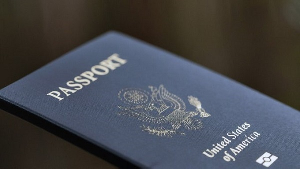
 File photo of an American passport
What makes a passport “powerful”? Well, a clear measure is travel openness, the ability to slip into destinations around the world with a breezy wave of your passport, no visa required.
The Henley Passport Index is one of several rankings measuring passport potency in this regard and, for the first time in its 20-year history, the US passport has fallen out of its top 10 list altogether.
Three Asian passports now command the top of the leaderboard: Singapore, with visa-free access to 193 destinations worldwide; South Korea, with access to 190; and Japan, with 189.
The United States, meanwhile, is down in 12th place in the latest quarterly ranking, tied with Malaysia.
Citizens of both nations enjoy visa-free access to 180 of the 227 countries and territories tracked by the index, which was created by the London-based global citizenship and residence advisory firm Henley & Partners, and uses exclusive data from the International Air Transport Association. And because Henley counts multiple countries with the same score as a single spot in its standings, there are actually 36 countries that outrank the US on the list.
Back in 2014, the US held the No.1 spot, and in July this year it was still clinging onto the top 10. So what’s behind this further descent?
It’s down to a series of access changes. In April, Brazil withdrew visa-free access for citizens from the US, Canada and Australia due to a lack of reciprocity. China has been introducing more welcoming policies, offering visa exemptions for dozens of mostly European countries, including Germany and France, but the US hasn’t made the cut.
Papua New Guinea and Myanmar have also tweaked their entry policies, which boosted other passports’ rankings while further eroding that of the US. The final blow, the latest report from the index says, was Somalia’s launch of a new eVisa system and Vietnam’s exclusion of the US from its latest visa-free additions.
“The declining strength of the US passport over the past decade is more than just a reshuffle in rankings — it signals a fundamental shift in global mobility and soft power dynamics,” said Christian H. Kaelin, chair of Henley & Partners, in a statement. “Nations that embrace openness and cooperation are surging ahead, while those resting on past privilege are being left behind.”
Commenting in July 2025 on the ailing performance of the US passport in the index, Richard Quest, CNN Business editor-at-large, noted how travel openness was being affected by the introduction of new restrictions such as ESTAs in the European Union and in the UK.
“Can we make a linkage, if you will, to immigration policies of the Trump administration?” said Quest. “Yes, you probably can, at some level, say there is a direct relation between one and the other.”
However, he added, the passports at the top of the leaderboard are still highly desirable with very few restrictions overall. “There are certainly citizenships that give greater access and availability to travel,” said Quest, and there are wealthy individuals who seek to obtain them through investment schemes, such as the $5 million “gold card” proposed by Trump in February. Henley & Partners advises its clients upon just these kind of residence and citizenship opportunities.
“But for the average person, it’s not a jot of difference,” said Quest. “You’ve got your passport, you’ve got where you are. Learn and live with it.”
Watch the latest edition of BizTech below:



Copyright © 1994 - 2026 GhanaWeb. All rights reserved.










