



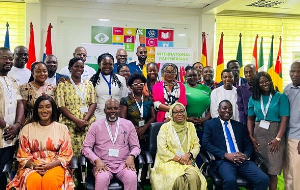
 Delegation from WASCAL at the event
The West African Science Service Centre on Climate Change and Adapted Land Use (WASCAL) has called for a transition from climate-related discussions and policy declarations to concrete actions that deliver measurable impact in communities across the country and the wider West African sub-region.
Speaking at a World Environment Day 2026 dialogue in Accra, WASCAL Executive Director Prof. Emmanuel Wendsongré Ramdé said climate interventions must move beyond scientific research and policy formulation to practical implementation that directly benefits communities.
“On climate action, we must move from talks, declarations and seminars into action. We at WASCAL believe that climate must go beyond just science. We must move from science to real action. Communities must feel the action,” he said.
The event, organised under the theme ‘From Global Commitments to Practical Implementation – Youth, Science and Diplomacy for Climate Action‘, brought together policymakers, scientists, media practitioners, youth leaders and development partners to discuss pathways for accelerating climate action.
Prof. Ramdé noted that while many institutions issue statements and commitments during environmental observances, the real challenge lies in translating scientific findings into solutions which address the everyday realities of citizens.
He also welcomed government’s decision to begin implementing a ban on styrofoam products next year, describing it as a positive step toward tackling plastic pollution.
“The use of plastics is really an environmental threat and government has taken a bold decision to ban plastics, starting with styrofoam. We believe that it is a good start,” he said, adding that authorities could eventually extend restrictions to other non-degradable plastic products.
Representing the Minister of State for Climate Change and Sustainability, Director of Monitoring and Evaluation Moses Ayamga assured that the country is committed to moving “from the era of rhetoric to the age of rigorous, practical implementation”.
He reiterated that climate change poses continuous significant threats to livelihoods, food security and ecosystems, making urgent action necessary.
“For us in Ghana, climate change is not a theoretical forecast; it is a lived reality. We see it in the erratic floods that sweep through our streets; the droughts that threaten our harvests; the heat stresses that burden our people; and the degradation of ecosystems which sustain us.”Ghana business insights
He identified youth engagement, science and diplomacy as critical pillars for advancing climate action and called for stronger collaboration among governments, researchers, development partners and communities.
He commended the Climate Change Action Now (CCAN) initiative, describing it as an important platform for translating scientific knowledge into community-based solutions.
Panel discussions during the event highlighted the importance of innovation, communication, climate finance and youth participation in addressing environmental challenges.
Esther Kyerewaa Twumasi, Co-Founder of the Chamber of Women in Agribusiness Ghana (CHAWA), stressed that scientific research and innovation must be made accessible to local communities if climate solutions are to achieve meaningful results.
“Science, research and innovation play a very key role. If they leave the laboratory and get to the field … that is when we feel the impact,” she said.
She further urged stakeholders to communicate climate solutions in local languages and through practical demonstrations that ordinary citizens can easily understand and adopt.
Business Week editor Foster Kofi Ahovi highlighted opportunities presented by international partnerships, particularly in climate finance, technology transfer and research collaboration.
He said stronger engagement with multilateral institutions, donor agencies and development partners could help Ghana access resources needed to implement climate adaptation and mitigation programmes, strengthen renewable energy systems and restore degraded ecosystems.
Climate advocate and author Priscilla Korlekour Agyeman underscored the need for introducing climate education at an early age to build a generation that is environmentally conscious and resilient.
She noted that climate change education remains limited within Ghana’s school curriculum and called for greater investment in educational materials targetted at children.Ghana business insights
Nana Sean Yaw Agyei Sikapa Agyemang, a serial entrepreneur and policy advocate, argued that climate action efforts will gain greater traction if they are linked to entrepreneurship and job creation.
He noted that many young people are preoccupied with economic survival and stressed the need for climate initiatives which provide tangible livelihood opportunities while addressing environmental challenges.
Meanwhile, journalist and broadcaster Doreen Ampofo emphasised media responsibility in bridging the communication gap between policymakers and citizens.
According to her, journalists must simplify technical climate policies and commitments so that ordinary citizens can understand their implications and hold governments accountable for implementation.
The dialogue echoed renewed calls for stronger collaboration among governments, researchers, media, youth groups and development partners to ensure climate policies are translated into tangible action capable of building resilience and safeguarding livelihoods.

Copyright © 1994 - 2026 GhanaWeb. All rights reserved.










