



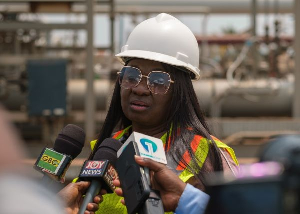
 Chafari Kanya Hannawa is the Director-General of the West African Gas Pipeline Authority
The Director-General of the West African Gas Pipeline Authority (WAGPA), Chafari Kanya Hannawa, has called for bold and coordinated regional strategies to unlock the full potential of natural gas as a catalyst for industrialisation and economic transformation in West Africa.
Delivering the opening address at the 2025 West Africa Gas Summit (WAGS) in Accra on June 11, 2025, where she also serves as Chairperson, Chafari Hannawa underscored the importance of visionary leadership and shared responsibility in advancing the region’s gas agenda.
She also emphasised the strategic value of WAGS as a platform to strengthen regional cooperation in the gas sector.
“Gas regionalisation is not a one-off achievement; it is a continuous process that requires synchronisation of national strategies with regional priorities. It also requires bold thinking, about interconnections with inland countries, about opportunities beyond our coastline, and about the infrastructure needed to take West African gas to new markets,” she stated.
She highlighted the vital role of public-private collaboration in building large-scale infrastructure, drawing lessons from the West African Gas Pipeline (WAGP) project.
“If there is one lesson the WAGP teaches us, it is that large-scale, cross-border energy infrastructure is impossible without private capital and technical expertise. The West African Gas Pipeline was a billion-dollar venture made possible because the private sector saw value in working with governments. That lesson is more relevant now than ever,” she noted.
Hannawa also stressed the importance of innovation and inclusive knowledge-sharing stating that, “We must create space for local entrepreneurs and innovators, while being open to global expertise. The development of our gas markets will require hybrid models, ones that combine local insights with international standards. That is how we ensure sustainability. That is how we ensure inclusion.”
Turning to regulation, she called for the evolution of national frameworks to attract investment and support long-term growth.
“At WAGPA, we understand that gas is a global commodity, and the regulatory environment must be agile, competitive and investment-friendly. The goal is not just compliance. The goal is to attract capital, drive down costs, and create certainty for investors and end-users alike, especially in the industrial sector, which we see as the engine of regional development,” she noted.
WAGPA, established by the 2003 West African Gas Pipeline Treaty signed by Benin, Ghana, Nigeria, and Togo, is the regional authority responsible for regulating the WAGP, a 678-kilometre pipeline spanning four countries.
The Director-General further described the WAGP as the "backbone" of the region’s gas market but emphasised that more is needed to unlock its full value.
“A backbone alone is not enough,” she declared.
Chafari Hannawa also announced that WAGPA has entered a three-year strategic partnership with The Gas Consortium, the summit organisers.
“This is not just a sponsorship but it is a commitment to building an enduring forum that will help unlock the immense potential of natural gas in West Africa,” she mentioned.
Hannawa outlined three strategic priorities for the summit which include; deepening regional cooperation by aligning national energy strategies with broader regional goals and expanding infrastructure to landlocked countries; driving public-private engagement by mobilising private capital and technical expertise for cross-border energy projects; and fostering innovation and knowledge sharing by supporting local entrepreneurship while embracing international best practices to ensure sustainability and inclusion.
Meanwhile, the summit will also feature remarks from Ghana’s Minister for Energy and Green Transition, John Abdulai Jinapor, who is expected to deliver a keynote address outlining Ghana’s evolving role in the regional gas landscape and its strategy for a just and green energy transition.
The 2025 West Africa Gas Summit is expected to generate strategic policy input, provide valuable business intelligence, and serve as a launchpad for project development, positioning the region to transition from being resource-rich to becoming a gas-powered engine for inclusive and sustainable industrial growth.
SP/MA
#TrendingGH: Drivers react to government’s new GH¢1 energy levy on petroleum products

Copyright © 1994 - 2026 GhanaWeb. All rights reserved.










