



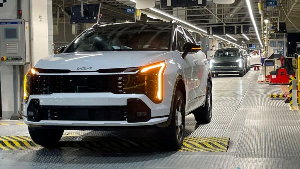
 Kia's giant plant Slovakia can produce 350,000 cars per year
In a giant factory surrounded by mountains covered in snow, a lift lowers the steel bodies of cars onto the start of an assembly line.
They've just been welded together by robots - there are 690 working in this factory.
Next an army of human workers in red trousers and white t-shirts will transform these steel shells into finished cars.
One of these vehicles drives off the end of the assembly line every minute, flashing its headlights.
This is the European factory of Korean car company Kia, just outside the city of Zilina in the north of Slovakia.
It represents, Kia says, an investment of €2.5bn ($2.9bn; £2.2bn).
Volkswagen also produces cars in Slovakia. So does Stellantis (formerly Peugeot-Citroen, Fiat and Chrysler), and Jaguar Land Rover. Volvo is opening an electric car factory here in 2027.
Slovakia, which is home to 5.4 million people, makes almost a million cars a year. This is a small number compared to the world's largest producers, such as the biggest, China, which manufacturers a whopping 31 million cars per annum.
Yet Slovakia is the number one producer on a per capita basis - relative to the size of its population.
"From a child, cars are my passion," says assembly line worker Marcel Pukhon, 48, one of the 3,700 people employed at the Kia plant.
"Now I am part of the team, and I can make the cars, so that's something that's a dream job."
Marcel lived in Northern Ireland and England before moving back to his native Slovakia to work here.
At the door insulation part of the assembly line I also talk to Simona Krnova, 23. She studied business before coming here. This is not her dream job, she tells me, but it does have its good points.
"Half of my family works here, so I wanted to try. I like the people," she says.
As for her salary, she earns €1,300 per month. "Good compared to other companies," she adds. And later on that will rise. Kia says the average at the facility is €2,400 per month.
That is substantially higher than the country's average monthly salary across the entire economy, which official figures show was €1,403 in 2023.
But at the same time it is considerably lower than the EU-wide average of €3,417.
Simona says she's proud of the fact that Slovakia makes so many cars. "I like the fact that thanks to that, the production here supports our society," she says.
Practically everyone who works at the Kia plant is Slovak. The Korean presence is a few dozen senior managers who live in a gated community they built specially on the outskirts of a village a couple of kilometres away.
When Slovakia was part of the Czechoslovak Socialist Republic, the cars it made were, by Western standards, shoddy, noisy, thirsty and slow.
But after the Velvet Revolution of 1989 sent the Communist rulers packing, Volkswagen started investing in Czechoslovak carmaker Skoda in 1991. By 2000 it owned the whole company.
Other foreign automobile manufacturers also started to invest in the new nations of the Czech Republic and Slovakia - the two parts of the former Czechoslovakia after its separation in 1993.
Car industry expert Peter Prokop says that back then the labour costs in Slovakia were 20% of those in Germany.
Prokop, the boss of Give Management Consulting, a Munich-based business that advises clients in the automotive sector, adds that Slovakia still has a considerable cost advantage.
"On one hand you still have lower wages," he says. "I would say 60% of the Western wages. But you have also high productivity. So it's definitely competitive."

Copyright © 1994 - 2026 GhanaWeb. All rights reserved.










