



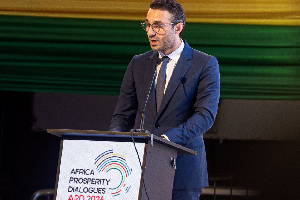
 Moh Damush, speaks at the Presidential and Business Leaders’ Dialogue
The Chief Executive Officer of Telecel Group, a leading African telecommunications operator, Moh Damush, has called for deliberate investment in digital connectivity and skills development across Africa, stressing that empowering SMEs, women, and young people is essential for sustainable economic growth on the continent.
Speaking at the Presidential and Business Leaders’ Dialogue during the Africa Prosperity Dialogues (APD) 2026 in Accra, Damush said Africa’s vast natural and human resources would remain underutilised without the digital infrastructure and skills needed to convert them into scalable economic solutions.
“Resources alone are like seeds kept in a jar—full of potential, but dormant,” he said. “It is knowledge, connectivity, and digital trade that turn them into solutions that transform lives.”
Damush emphasised the importance of building a digital single market to unlock the full benefits of the African Continental Free Trade Area (AfCFTA), noting its potential to serve a unified market of over 1.4 billion people through seamless cross-border payments, e-commerce, and data-driven trade.
According to him, Africa’s single market can only succeed if it is shaped from the grassroots by traders, creators, and innovators, particularly SMEs, women, and youth, who form the backbone of the continent’s economy.
“SMEs account for over 90 per cent of African businesses, while young people make up more than 60 per cent of our population. Yet too often, they are treated as beneficiaries rather than builders. Empowering SMEs, women, and youth is not charity; it is an economic necessity,” Damush stated.
He noted that women-led businesses are 17 per cent more likely to adopt digital tools when cross-border trade barriers are reduced, highlighting connectivity as a critical enabler for women’s economic participation and youth innovation.
Telecel Group, which operates across several African countries with its largest presence in Ghana, is investing heavily in initiatives that promote digital inclusion, entrepreneurship, and skills development.
These include the Africa Start-Up Initiative Programme, DigiTech Academy, and Startocode, which aims to train 100,000 Ghanaian youth under the Government’s One Million Coders Programme. The company’s Women in Business initiative also supports women-led SMEs with access to digital tools, financing, and training.
The Africa Prosperity Dialogues 2026, held from 4th to 6th February at the Accra International Conference Centre, brought together heads of state, policymakers, business leaders, investors, entrepreneurs, and youth advocates under the theme: “Empowering SMEs, Women & Youth in Africa’s Single Market: Innovate. Collaborate. Trade.”
As Africa continues to grapple with high unemployment and uneven access to digital technologies, Damush said closing the digital divide must be seen as both an economic and social imperative.
“Connectivity isn’t just an economic tool; it’s an equaliser. If we get this right, Africa will not simply prosper—it will redefine prosperity,” he concluded.

Copyright © 1994 - 2026 GhanaWeb. All rights reserved.










