



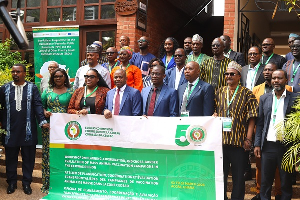
 ECOWAS has rallied West Africa for a cross-border animal vaccination drive
Senior veterinary officials, regional policymakers and international development partners have convened a “Cross-Border Planning, Coordination and Assessment” workshop to strengthen mass animal vaccination campaigns within the Economic Community of West African States (ECOWAS) zone.
The three-day workshop, held at the Coconut Grove Hotel in Accra on March 3, 2026, brought together dignitaries and representatives from across the sub-region.
Speaking at the event, the Principal Programme Officer (PPO) for Animal Health at the ECOWAS Regional Animal Health Centre (RAHC), Dr Koffi Eugene, outlined the overall objective of the workshop and the priority actions it seeks to advance in order to improve the control of transboundary animal diseases in West Africa and the Sahel.
Dr Koffi Eugene explained that harmonised mass vaccination campaigns will not only ensure a coordinated response to achieve maximum vaccination coverage but will also significantly protect the regional agricultural economy.
Cross-border women traders appeal for help as ECOWAS corridor challenges persist
“Harmonising vaccination campaigns not only allows for a coordinated response to achieve maximum vaccination coverage and prevent the spread of these diseases, but it also remains a strong initiative for better control and even the eradication of these diseases in the region, thereby protecting the regional agricultural economy,” he said.
Also addressing participants, the Chief Veterinary Officer at Ghana’s Ministry of Food and Agriculture, Veterinary Services Directorate, Dr Emmanuel Cudjo, described the workshop as both timely and strategic.
According to him, mass animal vaccination campaigns are among the most effective tools ECOWAS member states can adopt to control and eradicate transboundary animal diseases. However, he stressed that vaccination alone is not enough.
He noted that cross-border animal movement, porous boundaries and shared ecosystems require well-harmonised planning, data sharing and coordinated evaluation across member states.
Dr Cudjo further urged countries to use the workshop to reaffirm their commitment to strengthening surveillance and early warning systems.
“Let us use this workshop to reaffirm our dedication to strengthening surveillance and early warning systems, improving vaccine quality assurance and cold chain management, enhancing data management and reporting, and promoting community engagement and stakeholder awareness,” he stated.
The Africa Regional Representative of the World Organisation for Animal Health (WOAH), Simon Kihu, also highlighted the devastating impact of Peste des Petits Ruminants (PPR), describing it as a disease that “silently erodes food security, income and resilience.”
He emphasised that eradicating PPR should not be viewed solely as a veterinary responsibility but as a collective development priority. Financing alone, he noted, will not guarantee success; trust, transparency and unity of purpose are equally critical.
“When PPR decimates flocks, it strips women of financial autonomy, undermines household nutrition and weakens social standing. For young people, sheep and goats are often their first productive assets and pathway to entrepreneurship.
“Eradicating PPR is therefore not solely a veterinary obligation; it is an investment in human development, gender equity, employment and social stability,” Kihu said.
Speaking on behalf of Dr Huyam Salih, Director of the African Union–Interafrican Bureau for Animal Resources (AU-IBAR), Jean Marc Feusson stressed that the initiative aligns with the bureau’s Strategic Plan 2024–2028.
He noted that the plan prioritises strengthening animal health systems and controlling priority diseases; promoting competitive livestock production and improved market access; enhancing governance and coordination; and advancing agricultural and pastoral transformation under a One Health/One Welfare framework consistent with international SPS standards.
Sandra Awiaga, speaking on behalf of Ghana’s Minister of Foreign Affairs, underscored the critical role livestock plays in national and regional economies. She commended the ECOWAS Commission for its continued commitment to supporting member states in combating livestock diseases through coordinated vaccination campaigns, knowledge sharing and resource mobilisation.
“We all know that the livestock sector remains a cornerstone of our regional economy and rural livelihoods. In this light, I commend the ECOWAS Commission for remaining fully committed to supporting member states in the fight against livestock diseases through coordinated vaccination campaigns, knowledge sharing and resource mobilisation.
“This workshop is a proven and indispensable platform for harmonising our strategies, learning from our experiences and charting the path forward,” she said.
JHM/BAI
Ayawaso East By-Election: Low voter turnout recorded at St. Kizito polling station

Copyright © 1994 - 2026 GhanaWeb. All rights reserved.










