



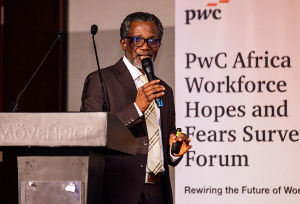
 Tsey is an Associate Director of Workforce Transformation at PwC
The PwC Africa Workforce Hopes and Fears Survey 2025 has revealed that nearly half the jobs across Africa are expected to be impacted by the Artificial Intelligence (AI) boom within the next three years.
It revealed that while workers on the continent report higher levels of optimism, trust in leadership, and sense of purpose at work than their global peers, critical risks of job displacement remain, particularly for entry-level positions.
The survey, which gathered responses from nearly 50,000 employees in 28 sectors across 48 countries, including five African nations, revealed that 49 percent of roles across the continent face potential impact from AI.
Presenting the survey’s findings in Accra, an Associate Director of Workforce Transformation at PwC Ghana said: “About 64 percent of Africans surveyed said they used AI in the past year. That is good news.”
“Technology is here, AI is here. The good news is that from our study, usage of AI is rising as compared to last year,” he added.
AI adoption across continent surges
The survey recorded a significant increase in AI usage among African workers. Daily AI users rose from 12 percent in 2024 to 17 percent in 2025, while weekly users increased from 14 percent to 18 percent over the same period. Infrequent usage dropped from 43 percent to 29 percent, suggesting deeper integration of AI tools into daily work routines.
West African workers are more enthusiastic about AI, with 55 percent expressing excitement about AI’s potential impact on their work compared to 51 percent across the entire African region. Only 10 percent of West African respondents reported confusion about AI’s implications.
A Partner of Consulting and Risk Services at PwC, Winfred King, noted that AI is no longer a future concept but a mainstream reality, transforming customer service, finance, supply chains, health care, and governments.
“The question for leaders is not ‘Is AI coming?’ but ‘How do we lead where AI is ever-present?'” he quizzed rhetorically.
Job security concerns
The survey revealed that 27 percent of managers and executives predicted that AI would impact junior roles, impacting entry-level positions. However, Mr. Tsey emphasised that AI will also create new opportunities.
“There’s going to be an impact on jobs, but AI is also creating a lot of jobs. What becomes important is how we collaborate, as individuals, business leaders, industry, and academia, to develop curricula that prepare young people so their skills are relevant when they enter the workforce,” he explained.
While 64 percent of African workers express confidence in their job security, only 35 percent believe their current skills will remain relevant over the next three years.
“Research has shown that within 18 months to two years, jobs will change. While most workers feel secure in their jobs in the short term, only 35 percent believe their skills will remain relevant for the next three years. This is a call for focus on development, upskilling, and reskilling,” Tsey said.
With Africa’s youth constituting more than 60 percent of the population, the survey highlighted rising demand for flexible working arrangements by the youth. It revealed that younger women in Africa showed less enthusiasm for traditional work environments, preferring hybrid models, people-focused roles, and clear career development pathways.
The research also identified elevated fatigue levels among Generation Z workers (ages 18-28), who feel more overwhelmed at work than older colleagues. Tsey therefore admonished business leaders to acknowledge the need to address this through flexible arrangements and supportive management practices.
“If you do not know what emotions your teams are going through, you will not be able to put in place measures to help them,” Tsey said.
He said this should be done in moderation with structures in place to promote and check efficiency. “How do we use technology to create efficiency? How do we use flexible work to ensure people do not have to go through traffic every time coming to work?” he quizzed.
Positive mood and strategic alignment are the strongest drivers of employee motivation across all sectors in Africa, the survey revealed, citing 74 percent of respondents confirming that mood is a key factor.
Tsey therefore advised that business leaders pay attention to salary, promotion, and career progression opportunities, indicating the survey revealed 45 percent of African workers plan to ask for a salary raise.
He urged them to balance investment in workforce development and employee satisfaction as these have the potential to impact the mood of workers, which has a bearing on motivation.
King outlined six priorities for business leaders navigating the transformation: task-level automation, data-driven decision-making, prioritisation of reskilling, responsible AI use, agile operating models, and psychological safety. He also urged employees to adopt a growth mindset, building hybrid skill sets, working with AI rather than against it, and strengthening data confidence.
“The future belongs to those who turn AI from a threat into a partner. At PwC, we believe the future is human-led and tech-powered. Organisations thrive when their people thrive,” he stated.

Copyright © 1994 - 2026 GhanaWeb. All rights reserved.










