



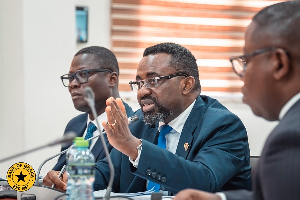
 Dr Johnson Asiama, Bank of Ghana Governor
The Bank of Ghana says it has strategically rebalanced its gold reserves to strengthen the resilience and usability of the country’s international reserves.
The measure, the Bank explained, was not only prudent as it aligned with international best practice, but also ensured that its wider efforts to stabilise inflation, the exchange rate, and the financial system remained well anchored.
Governor of the Bank of Ghana, Dr Johnson Pandit Asiama, told the Parliamentary Committee on Economy and Development on Monday, March 9, 2026, that while Ghana’s gold holdings remained part of the national reserves, the Bank adjusted their composition to reduce concentration risk.
“Ghana’s gold reserves remain part of our national reserves; what changed as part of this measure was the composition of those reserves,” he said.
Dr Asiama explained that gold holdings had grown from approximately 8.7 tonnes in 2021 to over 40 tonnes by October 2025, largely due to the Domestic Gold Purchase Programme. This increase, he noted, posed a concentration risk relative to the country’s overall portfolio of international reserves.
Measures in place to strengthen Bank of Ghana's resilience - Governor Asiama
Before the sale, gold represented about 42 percent of Ghana’s Gross International Reserves, a level higher than what is typically recommended for countries at Ghana’s stage of development.
The Governor noted that international best practices suggest that roughly one-fifth of reserves be held in gold as part of a diversified portfolio.
“While gold remains an important reserve asset, such a high concentration in a single asset class introduces portfolio concentration risk,” he said.
Dr Asiama added, “Maintaining an appropriate balance between gold and foreign currency assets is particularly important for countries such as Ghana. Reserves must not only be valuable, but also liquid, diversified, and readily usable when needed.”
The Governor emphasised that the move to convert a portion of gold holdings into foreign exchange assets is a routine part of central bank reserve management and does not represent a loss of national assets.
“First, this action did not represent a loss of Ghana’s national assets. The gold was converted into foreign exchange assets, which remain fully part of Ghana’s international reserves,” Dr Asiama explained.
He further noted that portfolio rebalancing ensures the reserves remain resilient under changing market conditions, preserving liquidity, safety, and diversification.
“This was a strategic diversification measure designed to strengthen the resilience and usability of Ghana’s international reserves, not a depletion of national assets,” he clarified.
MA

Copyright © 1994 - 2026 GhanaWeb. All rights reserved.










