



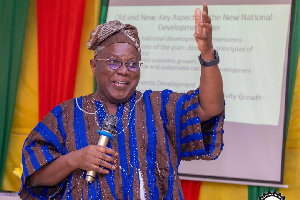
 Chairman of the National Development Planning Commission (NDPC), Nii Moi Thompson
The Chairman of the National Development Planning Commission (NDPC), Nii Moi Thompson, has underscored the need for stronger stakeholder engagement to ensure that Ghana’s national development agenda remains consistent regardless of changes in government.
Speaking during strategic consultations with Metropolitan, Municipal and District Assemblies (MMDAs) and key stakeholders in the Upper East Region, he said the exercise was aimed at gathering practical feedback from those implementing government policies to understand why some initiatives fail and how future plans can be improved.
“This time around, we want to hear from those who implement government policy on why some policies are not working and how we can address them in the next government,” he stated.
Dr Thompson explained that the Commission’s new planning approach would be anchored on the Directive Principles of State Policy in Chapter 6 of the 1992 Constitution of Ghana to ensure continuity across political administrations.
According to him, the Consolidated National Development Plan will guide the country’s long-term vision, tentatively called Ghana Vision 2057 and make national development objectives binding on all political parties.
“The Directive Principles are binding on all Ghanaians, including every political party, irrespective of what their manifestos say,” he stressed, adding that aligning party manifestos with these constitutional principles would help prevent policy disruptions after elections.
He also highlighted the importance of equitable development across all regions, cautioning against the excessive concentration of investment in Accra.
He observed that although the Greater Accra Region occupies a relatively small portion of Ghana’s land area, it attracts the majority of foreign direct investment.
“You cannot develop the country when resources are excessively concentrated in one part while others are left behind,” he said, stressing that strengthening local economic development across all districts will form the foundation of the country’s next national development plan.
The Director-General of the NDPC, Audrey Smock Amoah, also underscored the importance of effective planning in achieving Ghana’s development goals.
She explained that the Commission operates under Articles 86 and 87 of the 1992 Constitution of Ghana and is mandated to advise the President on development policy while coordinating the decentralised planning system from the national level down to the districts.
She indicated that the current policy framework, which runs from 2026 to 2029, focuses on “Resetting Ghana’s Agenda, Creating Jobs, Ensuring Accountability and Promoting Shared Prosperity.”
Dr Smock Amoah noted that district development plans play a critical role in governance and public sector accountability, as they serve as the basis for monitoring, evaluation, and resource allocation across government institutions.
“It is good to prepare plans, but it is even more important to implement them and monitor progress,” she said, urging Metropolitan, Municipal and District Chief Executives to ensure that their development plans reflect the aspirations of the people and align with national priorities.
The Donatus Akamugri Atanga, also highlighted the significance of the stakeholder engagement in shaping Ghana’s Consolidated National Development Plan.
He emphasised the region’s immense human potential, rich cultural heritage, and growing opportunities in agriculture, trade, renewable energy, and tourism, noting that effective planning requires active input from traditional authorities, local government leaders, technical officers, and development partners.
“Such a plan must transcend political cycles and provide a stable framework that guides policy, investment and development interventions for the benefit of present and future generations,” he said.
Meanwhile, learn of the story of the man behind the iconic Akwaaba frames in Ghana:

Copyright © 1994 - 2026 GhanaWeb. All rights reserved.










