



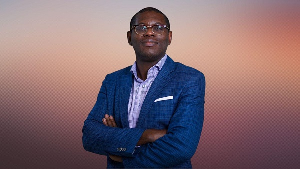
 Bright Simons is the Vice President of IMANI Africa
A Vice President of IMANI Africa, Bright Simons, has weighed in on President John Dramani Mahama’s commissioning of the MT Asharami Ghana in South Korea, pointing to what he describes as a decade-long pattern of ambitious energy sector agreements that have been undermined by weak institutions and costly legal disputes.
The MT Asharami Ghana is a 40,000-cubic-meter LPG carrier built by HD Hyundai Heavy Industries and owned by the Sahara Group.
It was unveiled in Ulsan, South Korea, as part of efforts to bolster Ghana's LPG supply chain.
The government has framed it as a significant step forward in energy security.
Simons, however, in a detailed analysis shared on X, introduced a concept called "katanomics," his term for a system in which political ambition is more than the institutional capacity needed to back it up.
He recalled that back in 2015, when Ghana was in the grip of the infamous "dumsor" power crisis and the Mahama government, facing an election and an angry electorates, signed an emergency gas deal with the West African Gas Limited (WAGL), a joint venture between Nigeria's NNPC and Sahara Group.
What followed, Simons says, was a masterclass in Katanomics in action.
“Ghana opened no letter of credit. Then suddenly signed a competing deal with Quantum that had been furiously paddling under water since 2013 before being supplanted by WAGL. Then took forever to do things that take hours.
“So, WAGL's sub-contractors started suing for non-payment. In January 2021, a London arbitration tribunal awarded WAGL $68.5 million against Government of Ghana. Another abandoned power project got $170 million,” he noted.
The bills, Simons noted, were handed to Ghanaian taxpayers who had no role in signing the deals.
"This is what katanomics looks like in practice: politics signs the deals, policy cannot honour them, and the legal bill goes to citizens who had no vote in any of it," he wrote.
Simons further pointed to the Tema LNG terminal, physically completed for years but still yet to receive commercial cargo, as further evidence of the gap between Ghana's energy announcements and their execution.
Simons acknowledged that the vessel could improve supply reliability and strengthen Ghana's clean cooking infrastructure. But he insists the fundamental question remains unanswered.
"The real issue is whether the policy environment can sustain long-term energy infrastructure without collapsing under political and regulatory contradictions.
"The katanomic market doesn't reward the visionary. It rewards those patient enough to outlast it,” he said.
See the post below:
Ghana's president flew to South Korea last week to commission a Nigerian gas ship. Trust me, Pan-African notwithstanding, that is not a regular sight.
— Bright Simons (@BBSimons) March 15, 2026
On the surface: routine economic diplomacy. Bubbling beneath: a truly operatic saga of corporate resilience in a katanomic…

Copyright © 1994 - 2026 GhanaWeb. All rights reserved.










