



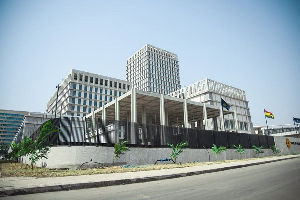
 Bank of Ghana headquarters
Ghana's public finances recorded a notable turnaround at the end of 2025, with the country’s total public debt falling to GH¢641 billion in December, according to the latest data from the Bank of Ghana.
This represents a slight drop from GH¢644.6 billion in November 2025, but a more significant decline from GH¢726.7 billion recorded in December 2024. Overall, the public debt stock reduced by GH¢82.1 billion over the year, bringing the debt-to-GDP ratio down sharply from 61.8 percent to 45.3 percent.
While the figures show improvement in cedi terms, the situation looks different when measured in US dollars as Ghana’s total debt increased to $61.3 billion in December 2025, up from $49.4 billion a year earlier.
Ghana weighs local bids for $1 billion revival of Gold Fields' Damang Mine
This increase is largely due to exchange rate movements, with the cedi weakening to about GH¢10.45 to the dollar. Despite this, the lower debt-to-GDP ratio suggests the economy is gradually stabilising.
Domestic vs External Debt
A closer look at the debt shows contrasting trends:
External debt fell significantly in cedi terms to GH¢307.2 billion, down from GH¢416.8 billion in December 2024.
Domestic debt, however, increased to GH¢333.8 billion, reflecting the government’s growing reliance on local borrowing.
Additionally, government revenue strengthened toward the end of the year, reaching 16.1 percent of GDP in December 2025, up from 13.4 percent in November. Tax revenue remained the main source, contributing 13.1 percent of GDP.
At the same time, government spending was kept at 16.1 percent of GDP, slightly lower than the previous year as capital spending remained low at 1.4 percent of GDP.
As a result, the fiscal deficit narrowed to 3.1 percent of GDP, down from 5.2 percent in 2024. The government also recorded a primary surplus of 0.5 percent of GDP, meaning it generated more revenue than it spent before interest payments.
What this means for government and citizens
For the government, the drop in debt and improved fiscal balance provide some breathing room. It reduces pressure on public finances and may make it easier to borrow at better rates or invest in key sectors.
For citizens and the business community, the impact is more gradual but important as lower debt and tighter fiscal discipline can help stabilise the economy, support the cedi, and reduce inflation over time.
However, continued reliance on domestic borrowing and limited capital spending may affect job creation and infrastructure development in the short term.
Overall, the recent data points to early signs of economic recovery, although sustaining these gains will depend on consistent revenue growth, controlled spending, and broader economic expansion.
MA

Copyright © 1994 - 2026 GhanaWeb. All rights reserved.










