



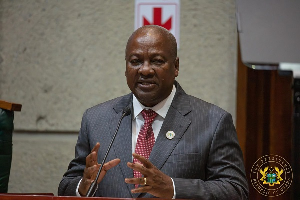
 President John Dramani Mahama
President John Dramani Mahama has disclosed that Ghana holds enough petroleum stocks to last for approximately six weeks as the ongoing conflict involving the United States, Israel and Iran continues to push global oil prices into uncertainty, and that the government is moving urgently to secure additional supplies.
President Mahama made the disclosure on Friday while addressing the World Affairs Council in Philadelphia, where he was asked about the resilience of Ghana’s economy in the face of external shocks.
He said Ghana had approached this particular shock with greater stability than it had managed in similar situations in the past, and that so far the economy had not been severely affected.
However, he was candid about the risks, acknowledging that fuel prices had a direct bearing on virtually every sector of the economy, from transportation and the movement of goods to electricity generation.
“We are taking steps to ensure that the economy is cushioned,” President Mahama said, adding that the government was making what he described as a “real push” to procure additional petroleum stocks to help stabilise fuel prices at home.
He said he hoped the conflict would be brought to an end quickly, expressing the wish that cooler heads would prevail in Washington, Tehran and Jerusalem. “Fingers crossed, we hope that God will touch the hearts of President Trump and Iran and Netanyahu to bring this conflict to an end as quickly as possible,” he told the gathering.
The disclosure comes as Ghana continues to implement what President Mahama has called a reset agenda aimed at building an economy resilient enough to absorb external shocks, a vulnerability he said had repeatedly derailed Ghana’s economic progress over the years whenever global conditions turned against the country.
He pointed to Ghana’s economic performance as grounds for cautious confidence, saying inflation was down, interest rates had fallen and the economy had recorded a growth rate of 6.1 percent by the third quarter of 2025.
The currency, he said, had also stabilised. The test, he argued, was whether those gains could be protected when the world outside Ghana’s borders became unpredictable.

Copyright © 1994 - 2026 GhanaWeb. All rights reserved.










