



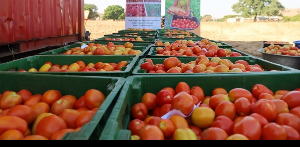
 Stacks of packaged tomatoes | File photo
GhanaWeb Feature by Veronica P Onuman
Ghana’s food security narrative is increasingly being shaped not by long-term resilience, but by short-term relief.
The recent decision by Burkina Faso to lift its ban on tomato exports, floods destroying farmlands, and government-backed poultry interventions popularly captured in the phrase “nkoko nkete nkete,” among other interventions, together appear to paint a picture that is far more fragile than what official optimism suggests.
It would be recalled that on March 19, 2026, Burkina Faso announced a ban on the export of tomatoes, a development that posed a direct supply challenge to Ghana.
Thankfully, on April 2, 2026, the ban was lifted, paving the way for neighbouring countries, including Ghana, to commence tomato trade with Burkina Faso.
The Ministry of Trade, Agribusiness and Industry, in a statement on April 2, 2026, indicated that one of five key meetings held by Trade Minister Elizabeth Ofosu-Adjare and her Burkinabe counterparts on the margins of the WTO MC14 in Yaoundé, Cameroon, directly contributed to the removal of trade restrictions.
“This development is a positive outcome of ongoing bilateral engagements between Ghana and Burkina Faso,” the statement said.
Why Burkina Faso banned the export of tomatoes – Dr Otokunor explains
A temporary lifeline: The tomato import reality
The lifting of Burkina Faso’s export restriction has been welcomed as a breakthrough, expected to “ease supply shortages and stabilise local markets.”
However, the speed at which Ghana’s tomato market destabilised during the ban reveals a deeper truth:
1. A short disruption in Burkina Faso led to immediate shortages and price spikes.
2. Policymakers openly acknowledged the risk to national food security.
This exposes a structural weakness:
Ghana’s food system depends significantly on external supply chains, even for basic staples like tomatoes.
The lifting of the ban is therefore not a solution, but a reminder that food stability is partially outsourced.
Climate Shocks: When floods become food shocks
At the same time, as Ghana enters the rainy season, flooding across farming regions is anticipated, and this could heavily impact food security by eroding domestic capacity.
Such events may inadvertently lead to crops being destroyed before harvest, planting cycles being disrupted, and increased post-harvest losses.
It is noteworthy to state that these are not isolated agricultural problems; they translate directly into reduced food availability in the coming months, higher market prices, and greater dependence on imports.
Tomato Crisis: 'Act now or lose your office' - FABAG tells Agric Ministry
In effect, climate change is turning into an economic force, steadily weakening Ghana’s ability to feed itself.
“Nkoko nkete nkete”: Policy meets lived reality
This government intervention in poultry production was meant to reduce imports and boost local supply. Yet the phrase “nkoko nkete nkete,” now widely propagated, may not, as of now, have made the impact that was intended.
Though this may not be because the intervention was inadequate, other prevailing factors appear to detract from the intended outcome.
This is evident in the smaller portions of protein being purchased in markets, and households adjusting to declining purchasing power, leading to a shift from balanced diets to survival consumption.
So, this is not about availability alone. It is about access.
Food may exist in the market, but many cannot afford it in meaningful quantities.
The real state of Ghana’s food security
Considering the three realities above, it appears the government may have to undertake a careful assessment of the country’s food security situation by reviewing existing models to restrategise and amend policies to safeguard the situation.
1. Dependence disguised as stability
Imports from countries like Burkina Faso are not supplementary; they are essential. Any disruption quickly becomes a domestic crisis.
2. Production under pressure
Floods and weak agricultural infrastructure mean local production is seasonal, vulnerable, and insufficiently buffered against shocks.
3. Affordability crisis
Even when food is available, prices remain volatile, household incomes lag behind inflation, and nutrition quality is declining.
What this means for ordinary Ghanaians
In the short term, tomato prices may stabilise due to resumed imports, poultry and protein remain expensive, and households continue to adjust downward in consumption.
In the medium term, more frequent food price shocks are expected, increased reliance on imports is also expected, and persistent “nkete nkete” consumption patterns remain unpredictable.
In the long term, if structural issues persist, chronic food inflation is anticipated, widening inequality in food access will persist, and gradual nutritional decline, especially among low-income households, will remain a concern.
The bigger picture: a system managing crisis, not preventing it
Government interventions such as irrigation, poultry programs, and value chain improvements are steps in the right direction. But current evidence suggests Ghana is operating in a reactive mode.
Ghana is acting in reactive mode because it imports to augment shortages and intervenes only after floods to stabilise prices temporarily.
What is missing is a system that ensures year-round production, reduced import dependence, and stable and affordable food access.
In summary
The lifting of Burkina Faso’s tomato export ban offers relief, but it also exposes a critical vulnerability.
Floods highlight environmental fragility, while “nkoko nkete nkete” reflects economic strain at the household level.
Together, they point to a sobering conclusion that Ghana is not facing an immediate food crisis, but it is living on the edge of one.
For the ordinary citizen, food security today means not just finding food, but affording it, sustaining it, and trusting that it will still be available tomorrow.
'JJ Rawlings did not die of COVID 19' - Dr Nyaho Tamakloe

Copyright © 1994 - 2026 GhanaWeb. All rights reserved.










