



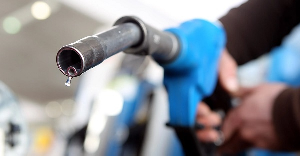
 File photo of a fuel pump
The conflict in the Middle East begins to cast its shadow on Ghana’s economy, as fuel and transport prices see marginal month-on-month increases as crude oil surges past US$100 per barrel, up from the US$60 to US$70 range.
Overall, inflation eased to 3.2 percent year-on-year in March 2026, from the 22.4% in March 2025, marking a 15-month consecutive decline, figures from the Ghana Statistical Service (GSS) show.
However, month-on-month, the March 2026 Consumer Price Index (CPI) and inflation data showed that the US-Iran conflict marginally pushed up the inflation for petrol and diesel, as well as taxi and public transport fares.
For petrol, the monthly inflation increased to 3.1 percent in March 2026 compared to the 0.2% deflation recorded last year, although year-on-year, the commodity saw a deflation of 25.6% in March 2026 compared to an inflation figure of 2.9% in 2025.
Diesel had a 1.4 percent rise in inflation in March 2026, whereas the same commodity saw a decline of 0.4% in inflation in March 2025, while the year-on-year deflation of 22.6% in March 2026 was higher than the 2.4 percent deflation seen last year.
Taxi fares increased with a month-on-month inflation of 0.2% in March 2026, compared to no price change in fares in March 2025, but year-on-year inflation for taxi fares eased to 6.8% in March 2026 unlike the 16.9% hike a year ago.
Nonetheless, figures from the latest CPI showed that bus and trotro fares recorded no month-on-month changes in inflation for March 2026, although there was a 0.1 increase the same period last year.
On year-on-year basis, inflation for bus and commercial vehicles (trotro) fares declined by 6.2% in March 2026, whereas the year-on-year inflation for March 2025 was a 9% increase, the GSS figures showed.
Dr Alhassan Iddrisu, the Government Statistician, in response to a question from the Ghana News Agency on the marginal month-on-month increases in fuel prices and transport fares inflation, at the release of the March 2026 CPI and Inflation, called for attention from policymakers, businesses, and households to the emerging inflationary pressures and the need for prudent measures to mitigate their impact on the cost of living.
“The transmission mechanism from the Middle East conflict to Ghanaian consumer prices is well understood, direct, and already in motion. We are looking at crude oil prices over US$100 per barrel, but they were earlier around US $60 to US $70,” he said.
Dr Iddrisu explained that for an oil-importing economy like Ghana, the most immediate and visible channel of the oil price shock was transportation, saying: “if you have crude oil prices going up and you import crude into the country, then the prices of all the things we need are likely to go up.”
He noted that the transport division had been recording negative year-on-year inflation of 7.3%, one of the most powerful disinflationary forces in the entire basket, driven by significantly lower fuel prices compared to a year earlier.
He was quick to add that a sustained reversal of fuel prices threatened to eliminate the disinflationary contribution entirely, removing one of the key supports that has kept headline inflation on its downward trend.
Such situation, he said, would push up the cost of refined petroleum products at the pump, putting pressure on taxi, bus and trotro fares, as well as commercial haulage rate in the country.
The Government Statistician framed solutions to the current development at two levels – global and domestic – noting that both must be pursued with equal urgency.
At the international level, he called on the global community to intensify diplomatic and political efforts to end the US- Iran conflict as quickly as possible, saying: “nobody will win if this war continues. It will all be better if the war comes to an end abruptly.”
On the domestic front, he said building economic buffers was the critical first line of defence, noting that countries that had built up foreign exchange reserves, maintained fiscal space, and kept their debt positions manageable were in a far stronger position to absorb and cushion the impact of a global energy price spike.
He also encouraged authorities to watch the situation critically and ensure that the available fiscal and monetary tools were used in the manner that would continue to make the economy resilient.
On the human cost of rising prices, he urged the government and relevant stakeholders to institute measures to alleviate the impact on vulnerable groups, pointing to targeted subsidies and a review of taxes and levies on petroleum products as options to consider.
“You would want to provide some respite for the people and the consumers. But the combination must be done in a way that it doesn’t put the economy at risk in the medium to long-term,” Dr Iddrisu said.

Copyright © 1994 - 2026 GhanaWeb. All rights reserved.










