



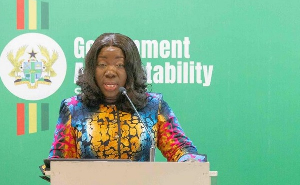
 Elizabeth Ofosu-Adjare is the Minister of Trade, Agribusiness and Industry
The government is taking a major step to transform Ghana’s agricultural sector, with the Ministry of Trade, Agribusiness and Industry submitting a new National Agribusiness Policy to Cabinet for approval.
Speaking at the second day of the Kwahu Business Forum on Saturday, April 4, 2026, the Sector Minister, Elizabeth Ofosu-Adjare, said the policy is aimed at helping Ghana stop losing billions of dollars from exporting raw agricultural produce without adding value.
According to her, the country is currently missing out on an estimated $2.5 billion every year due to the export of unprocessed commodities, an issue the new policy seeks to address head-on.
“It sets out a deliberate pathway to capturing the value that currently leaves Ghana in the form of unprocessed agricultural commodities,” she stated.
“Ghana loses an estimated 2.5 billion annually in unrealised value from raw agricultural produce alone, an amount that represents not a lament, but a clear opportunity this government is determined to seize,” she added.
She explained that the policy is part of a broader push by the government to industrialise the economy, strengthen local production, and ensure that more of the value generated from agriculture stays within Ghana.
Beyond agribusiness, the minister revealed that her ministry has also developed new industrial policy frameworks targeting key sectors such as textiles and garments, pharmaceuticals, and automotive components, areas seen as critical to Ghana’s economic growth.
“My ministry has, for the first time, developed dedicated industrial policy frameworks for the textiles and garments, pharmaceutical, and automotive component sectors,” she said.
“These frameworks are designed to provide regulatory clarity, investment incentives, and a standard architecture that enterprises in their sector require to grow with confidence,” she noted, adding that the policies will soon be submitted to Cabinet.
She further disclosed that the government is working to revive special economic zones across the country, with a renewed focus on agro-processing and light manufacturing to make them more productive and impactful.
“We are also advancing the revitalisation of our special economic zones, repositioning them as active industrial ecosystems oriented towards agro-processing and light manufacturing rather than passive export enclaves,” she said.
Touching on the role of the private sector, the Minister acknowledged the challenges many Ghanaian entrepreneurs face but expressed confidence in their ability to drive growth if given the right support.
“Ghanaian entrepreneurs are capable of building viable enterprises across agribusiness processing, manufacturing, services, and trade, and government remains committed to supporting them,” she emphasised.
NA/AM
Watch as Mahama shares how Kwahu Business Forum was born in a Land Cruiser ride with Julius Debrah - Mahama

Copyright © 1994 - 2026 GhanaWeb. All rights reserved.










