



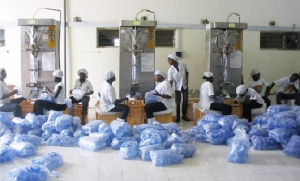
 A picture of sachet waters being packed
The cost of sachet water, an essential for many Ghanaian households, is once again under scrutiny, as the government moves to prevent a potential price hike.
The Ministry of Trade and Industry says it is exploring the use of locally sourced raw materials to reduce production costs and stabilise prices, while supporting producers facing rising expenses.
Speaking on JoyNews’ AM Show on Monday, April 6, Kofi Addo, Chief Commercial Officer and Director of Industrial Development at the Ministry, said the government acted swiftly after signals of an impending price increase.
Sachet water prices to increase from April 6
“You will recall, last week, we had the message that this increment was coming on board, and as a ministry, for the protection of our consumers and to ensure price stability in the environment, we quickly started the engagement with the manufacturers and producers,” he said.
He noted that the government’s immediate priority is to maintain price stability while engaging all stakeholders in the production chain.
“So all that we did is to make sure that we bring stability and to protect our consumers,” he added.
Additionally, a key meeting has been scheduled for Wednesday April 8, 2026, with manufacturers and producers to address the drivers of the anticipated price hike, particularly rising input costs.
“What we are doing is that we are having this meeting to understand the issues that led to the increment. We also want to make sure that all the other players are brought on board so that when we come out with the solution, everybody will be happy along the value chain,” he said.
“On Wednesday, we are bringing the manufacturers and the producers to make sure that these issues are resolved with the speed of light,” he stated.
At the core of the challenge is Ghana’s reliance on imported raw materials, especially polymers used in sachet production, which have become more expensive due to global price fluctuations and supply disruptions.
Addo said the government is exploring local alternatives to reduce dependence on imports.
“As a ministry, we are very concerned about feeding the industry with available raw materials. In fact, that has been our mandate since the government took over,” he said.
“So what we are doing right now is speaking to other stakeholders in the value chain to see if we can have locally available polymers, which are the main ingredients in sachet production.”
He added that policy reforms are also underway to strengthen competition and improve pricing.
“As we are speaking right now, the ministry is working on these two important documents to make sure that they are completed on time to support the issues you have raised,” he said.
Citing external pressures, Addo pointed to global conflicts and disruptions to shipping routes.
“The economic environment is also good apart from this war and the closure of the Straits of Hormuz, which is not allowing people to get their imports. That is why this price increment came about,” he said.
Despite the challenges, he assured that the government will ensure access to affordable inputs.
“If we are not able to get these raw materials locally, we will get them so that we will be able to have a competitive import price to support our producers,” he said.
He also confirmed that the Ministry will engage the Bank of Ghana over the refusal by some traders to accept lower-denomination coins.
NA/MA

Copyright © 1994 - 2026 GhanaWeb. All rights reserved.










