



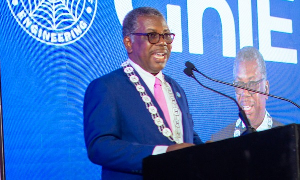
 Ing. Ludwig Annang Hesse is the president of GhIE
The Ghana Institution of Engineering (GhIE) has called on the Audit Service of Ghana to undertake an independent and comprehensive technical audit of road projects under the government’s flagship “Big Push” infrastructure programme, citing mounting concerns over procurement practices and project delivery.
In a statement issued on April 8, 2026, the Institution said the scale of investment, estimated at GH¢110 billion, with about GH¢85 billion already committed, requires “rigorous and independent scrutiny” to safeguard the national interest.
The call follows recent investigative reports by The Fourth Estate, which alleged the widespread use of single-source procurement and restricted tendering in contract awards by the Ministry of Roads and Highways.
Heath Goldfields failed to meet 80% technical mark in Damang Mine lease bid – Report
The revelations have sparked national debate over transparency, value for money, and compliance with procurement laws.
From a professional engineering standpoint, GhIE warned that the unprecedented level of public expenditure cannot proceed without credible oversight.
“Such unprecedented public expenditure must be subjected to a credible audit process to safeguard the national interest, ensure that infrastructure delivery meets expected standards, and guarantee that every cedi invested delivers measurable value, efficiency, and tangible benefits to the Ghanaian people,” the statement said.
While acknowledging a directive by John Dramani Mahama for the Roads and Highways Minister to respond to the allegations, GhIE stressed that the situation demands independent verification.
“The gravity of the issues raised requires an independent audit by the Auditor-General to provide objective findings and restore public confidence,” it added.
The Institution grounded its request in Section 16 of the Audit Service Act, 2000 (Act 584), which empowers the Auditor-General to conduct special audits in the public interest and report to Parliament.
GhIE described this mandate as “critical at this juncture to reinforce accountability and institutional credibility.”
Beyond procurement concerns, the engineering body urged that the audit cover the full lifecycle of the projects, including feasibility studies, engineering design, environmental and social compliance, and implementation. It warned that “weaknesses at any stage can significantly affect cost, quality, and long-term sustainability.”
GhIE also pointed to existing legal frameworks, including the Public Procurement Act, 2003 (Act 663) and the Public Investment Management Regulations, 2020 (LI 2411), which mandate competitive tendering and proper project planning processes.
It cautioned that deviations from these provisions risk “undermining public trust, weakening accountability, and ultimately compromising value for money.”
The Institution clarified that its intervention is not intended to apportion blame but to strengthen systems.
“This call is not intended to apportion blame, but to establish clear standards for public project execution, identify systemic gaps, and strengthen infrastructure delivery in Ghana,” it noted.
GhIE further indicated its readiness to support the audit process with technical expertise to ensure credibility and comprehensiveness.
“At a time of significant national investment, swift and decisive action is needed to ensure transparency, accountability, and value for money in the delivery of these critical projects,” the statement concluded.

Copyright © 1994 - 2026 GhanaWeb. All rights reserved.










