



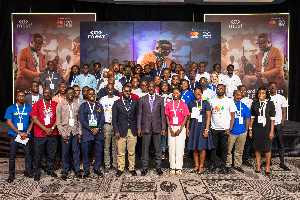
 Photo of the third cohort of the Mastercard Foundation EdTech Fellowship
MEST Africa, in partnership with the Mastercard Foundation, today officially announced 12 EdTech companies selected for the third cohort of the Mastercard Foundation EdTech Fellowship.
The companies bring the number of Ghanaian owned solutions accelerated through the Fellowship to 36.
The 2026 cohort exemplifies the EdTech Fellowship’s commitment to versatility and regional inclusion, with solutions spanning: innovative learning tools, teacher training and inclusivity, school and teaching management platforms, learning platforms, and exam preparation and gamified learning tools across seven (7) regions in Ghana.
Since the program was launched in Ghana in 2024, the Mastercard Foundation EdTech Fellowship implemented by MEST Africa has impacted 691,376 learners across the country and the current cohort will be building on this reach.
“This milestone proves that high-quality digital education is no longer a distant goal but a present reality, marking a major shift in how knowledge is delivered in the modern classroom”, said Angela Duho, MESTx Senior Manager, MEST Africa.
Central to this impact is a commitment to making sure no one is left behind, regardless of gender, location, or ability. The program has achieved a remarkable 48.8% female representation, reaching 337,055 young women to ensure a diverse future for Ghana’s tech economy.
This reach extends to the country's most remote areas, providing 105,234 rural learners with world-class resources and supporting 19,880 people with disabilities. By removing these traditional barriers, the fellowship is fostering an environment where every learner has the opportunity to excel.
"This was an incredibly impactful and exciting journey for our entire team," said Bennette Osae Addo, Programs Manager, Academic Talent Development Program, Cohort 2 company.
"The fellowship's timing was perfect, arriving as we positioned ourselves for a significant high-growth expansion phase. We leveraged the program's resources, mentorship, and network to refine our product-market fit, streamline operations, and build a robust foundation. The connections and lessons learned have been invaluable, directly contributing to our accelerated growth post-program. We are now much better equipped to handle the complexities of scaling."
The selected companies for MEST Africa’s 2026 Mastercard Foundation EdTech Fellowship are:
1. Robotek: Robotek shifts students from competitive to collaborative thinking. By providing proprietary robotics kits, tailored curricula, and lab infrastructure, Robotek equips educators with everything they need to help learners build functional, real-world systems.
2. Syllabus Gh: Syllabus Gh provides Ghanaian students with a personalised, data-driven study companion. Unlike generic learning platforms, every lesson and quiz is 100% mapped to the national BECE and WASSCE syllabi, ensuring students only study exactly what they need to pass.
3. Keep Premium: Keep Premium trains teachers directly in their own environments, ensuring they master the tools they have to make teaching more efficient and engaging for their students with an interactive teachers, students and parents dashboard for monitoring lesson planning.
4. Edutapcs Consult: Edutapcs equips teachers with accessible, practical, and NTC-aligned training, delivered through digital platforms and in-person programs to strengthen teaching effectiveness, support career development, and help educators successfully pass the Teacher’s Aptitude Test.
5. Jyncafey Training Consult: Jyncafey provides high-quality, curriculum-aligned Science and Mathematics lessons through multimedia resources that simplify complex concepts, overcome language barriers, and support undertrained teachers, ensuring every child can understand, retain, and enjoy STEM learning.
6. Supreme Concepts Ltd: myExamPal delivers a comprehensive EdTech solution that combines self-paced practice, standardised exam simulations, and gamified learning to help students excel academically, while offering parents and schools actionable insights to monitor progress, manage assessments, and enhance teaching effectiveness.
7. EduSpots: EduSpots provides a scalable, community-led EdTech model that equips local educators with practical digital tools, WhatsApp-based learning, digital skills training, and educational animations, enabling inclusive, high-quality, play-based education for underserved learners even in low-connectivity contexts.
8. Alanrose Enterprise: AlexLearn ACA offers a mobile-friendly, low-bandwidth e-learning platform that delivers interactive lessons, quizzes, and WASSCE-aligned practice, enabling students to learn anytime, track progress, and strengthen exam readiness while giving educators tools to monitor performance and provide targeted support.
9. Kokuromoti Publications: Kokuromoti offers a blended learning ecosystem that combines curriculum-aligned books, QR-linked bilingual video lessons, and a gamified mobile app, enabling students to understand concepts in both Twi and English while giving teachers and parents simple tools to support effective learning.
10. Literacy in Northern Ghana (LING): LING delivers a portable, offline digital learning server with curriculum-aligned STEM content, empowering teachers to run technology-enhanced lessons and giving students, especially girls, interactive, real-world STEM experiences without internet access.
11. Era Axis: Era Axis provides an inclusive, low-cost STEM learning system using e-waste and local materials that transforms learners into problem-solvers, connects education to real-world impact, and supports job creation and self-reliance.
12. MINEX 360 Ltd: SmartSapp streamlines school operations, enhances parent engagement, and provides actionable data for better student outcomes, all through an easy-to-use digital platform accessible on mobile and web.
“Technology is accelerating how education can reach those who have historically been excluded,” added Wariko Waita, Director, Centre for Innovative Teaching and Learning at the Mastercard Foundation.
“The EdTech Fellowship sits at the intersection of three powerful forces – education system transformation, inclusive technology-enabled solutions and sustainability of Africa’s EdTech entrepreneurship that is responsive to real needs, and capable of reaching millions across Ghana and Africa.”
The third cohort will over a six months acceleration period receive capacity building, network expansion, and refine their innovations to maximise their impact on African education.
Beyond expert-led mentorship and advisory sessions, each EdTech Fellow will receive up to $60,000 in equity-free funding, followed by an additional year of post-program support. The EdTech Fellowship was launched in 2019 by the Mastercard Foundation to support promising, Africa-led, owned growth-stage EdTech companies solving Africa's educational challenges.
In Ghana, the initiative is tackling critical gaps in K-12, higher education, and vocational training to transform the learning landscape.
For more information about the Mastercard Foundation EdTech Fellowship and other MEST Africa initiatives, click here.

Copyright © 1994 - 2026 GhanaWeb. All rights reserved.










