



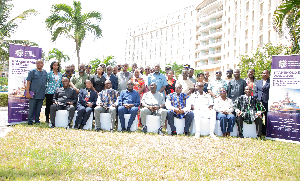
 A group photo of the participants at the meeting in Accra
Ghana has taken a decisive step toward unlocking the full potential of its maritime domain, with government officials and industry leaders declaring that the nation can no longer afford to overlook the foundational science of hydrography.
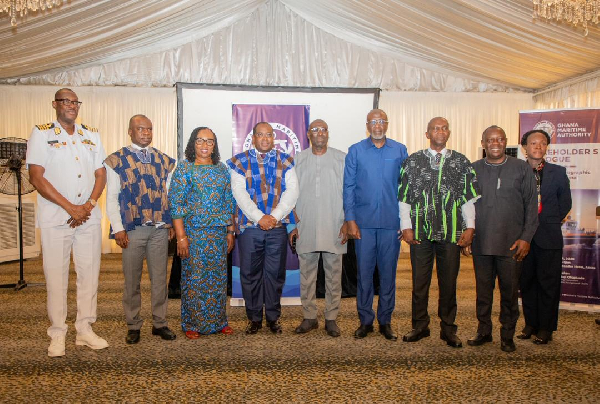
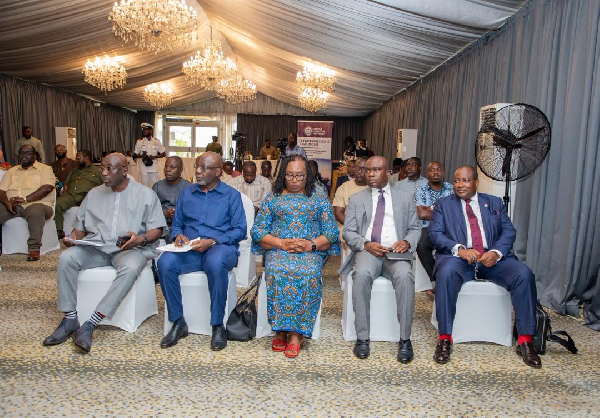
This was the focal point of discussions at a high-level stakeholders’ dialogue in Accra on Tuesday, April 14, 2026, which was convened under the theme “Building Hydrographic Capacity for National Development” by the Ministry of Transport and the Ghana Maritime Authority (GMA).
At the meeting, the state institutions rallied both local and regional partners to urgently address a critical gap: most of Ghana’s waters remain unsurveyed to requisite standards, posing significant risks to navigation, port efficiency, and the burgeoning blue economy.
Speaking on behalf of the Minister of Transport, Joseph Nikpe Bukari, a government representative opened the dialogue at the Movenpick Ambassador Hotel by stressing that “hydrography is the foundation of all activities at sea,” yet remains one of the most unrecognised sciences in national development.
“Inadequate charts increase the risk of accidents, which can lead to severe environmental damage, higher insurance premiums for goods, less optimal loading of ships, and longer, expensive shipping routes.
“As the world faces increasing threats from climate change and maritime insecurity, data generated by hydrographers becomes our first line of defense,” the minister’s address noted.
While acknowledging that Ghana is late in developing its hydrographic capacity, stakeholders unanimously agreed that better late than never.
The Ministry of Transport, through the GMA, has already established the National Hydrographic and Oceanographic Committee (NHOC) and supported Ghana’s membership in the International Hydrographic Organization (IHO).
A National Hydrographic Office (NHO) has also been created, though participants were informed that it must now be fully operationalised with survey and charting capacity, enhanced regulatory frameworks, and global partnerships.
The critical missing link, speakers emphasized, is not just policy but resources — and collective national will.
In a notable show of regional collaboration, the dialogue featured Rear Admiral Ayo Olugbode (Retired), Vice Chairman of the International Center for Electronic Navigational Chart and immediate past Hydrographer of the National Hydrographic Agency of Nigeria.
Nigeria was praised for its impressive strides in surveying and charting its waters, and Ghana’s Maritime Authority formally invited the Nigerian delegation to share its experience.
“It is always refreshing to have Big Brother Nigeria extend support to Ghana at moments like this,” the minister’s address stated.
A Call for Collective Resourcing
Perhaps the most direct call to action came during the closing remarks by the Board Chairperson of the Ghana Maritime Authority. While commending the GMA and the Ministry for driving the agenda, the Chairperson made it clear that the responsibility cannot rest on one institution alone.
“Collaboration, support, and the provision of adequate resources from all relevant stakeholders will be essential,” the Board Chairperson said. “Without singling out any agencies, I wish to call on the Ghana Ports and Harbours Authority, the Ghana Shippers Authority, the Petroleum Commission, and the Ghana National Petroleum Corporation to come on board fully to support this national agenda with resources.”
The Chairperson added that the Ghana Navy and other agencies have already shown strong indications of collaboration, and that spirit must now be strengthened.
“If we are able to successfully deliver on the vision we have discussed here,” the Board Chairperson concluded, “it will not only enhance our maritime industry but will also stand as a legacy for our nation — one that we can all be proud of.”
The dialogue ended with a commitment to operationalize the Nigerian delegation’s recommendations and a formal declaration that Ghana’s hydrographic development is now a shared national project.

Copyright © 1994 - 2026 GhanaWeb. All rights reserved.










