



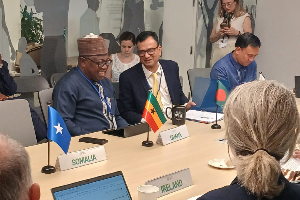
 Issifu Seidu speaks at Global Shield roundtable on climate risk financing in Washington DC
The Minister of State for Climate Change and Sustainability, Issifu Seidu, has called for intensified global efforts to strengthen fiscal and financial resilience to climate risks, as he participated in the Global Shield Partner and Climate Vulnerable Forum (CVF-V20) Roundtable held in Washington, D.C.
The high-level engagement brought together a broad spectrum of stakeholders, including policymakers, donor agencies, multilateral development banks (MDBs), climate funds, development partners, and private sector actors.
The roundtable aimed to catalyse coordinated and strategic action towards enhancing financial protection frameworks for countries most vulnerable to the adverse impacts of climate change.
The discussions were anchored on the urgent need to address the growing fiscal pressures that climate-related shocks continue to impose on vulnerable economies.
Participants examined how multilateral financing mechanisms can be more effectively structured and deployed to support pre-arranged disaster risk financing solutions.
These solutions, comprising both risk retention and risk transfer instruments, are essential at ensuring the availability of timely, predictable, and adequate financial resources to respond to residual risks arising from climate-induced events such as floods, droughts, and extreme weather conditions.
In his intervention, Hon. Seidu, speaking on behalf of Ghana in its capacity as a member of the CVF Troika, articulated the country’s perspective on the strategic importance of strengthening financial resilience frameworks.
He emphasized that while significant progress has been made in advancing climate finance initiatives, critical gaps remain in the accessibility, adequacy, and coordination of financial resources required to effectively manage climate risks.
The Minister highlighted the need for better alignment of financing envelopes, instruments, and partnerships at both the national and international levels. He noted that fragmented financing approaches often limit the effectiveness of interventions and underscored the importance of developing integrated and scalable financial solutions that can respond to the diverse and evolving needs of vulnerable countries.
Seidu further stressed that strengthening fiscal resilience is not only essential for immediate disaster response but also for safeguarding long-term development gains.
He underscored that climate-related shocks have the potential to reverse years of economic progress, particularly in developing countries, thereby necessitating proactive and forward-looking financial strategies.
The Minister also called for enhanced collaboration among governments, multilateral institutions, climate funds, and the private sector to leverage innovative financing instruments and technical expertise.
According to him, the private sector has a critical role to play in expanding the range and reach of financial tools available for climate risk management, including insurance-based solutions and blended finance mechanisms.
The roundtable provided a platform for stakeholders to exchange insights and best practices on strengthening financial protection systems under the Global Shield initiative.
It also highlighted the importance of ensuring that financing mechanisms are country-driven, context-specific, and aligned with national development priorities.
Participants reaffirmed the need to scale up support for pre-arranged financing mechanisms as a means of reducing reliance on ad hoc humanitarian responses, which are often delayed and insufficient.
By contrast, pre-arranged solutions offer a more efficient and reliable pathway for managing climate risks and enhancing resilience at both the national and community levels.
The meeting further underscored the critical role of multilateral development banks and climate funds in mobilising and channelling resources towards climate risk financing.
These institutions were encouraged to adopt more flexible and responsive financing models that can better meet the needs of vulnerable countries.
In addition, discussions highlighted the importance of closing existing protection gaps, particularly in countries that face disproportionate exposure to climate risks despite contributing minimally to global greenhouse gas emissions.
In this regard, Seidu reiterated Ghana’s commitment to climate justice and equitable access to climate finance.
The Global Shield Roundtable ultimately reinforced the shared recognition that addressing climate risks requires a collective and sustained effort.
It called for stronger partnerships, improved coordination, and increased investment in innovative financial solutions to build resilience against the escalating impacts of climate change.
As the global community continues to grapple with the intensifying effects of climate change, the outcomes of the roundtable serve as a timely reminder of the need for decisive action.
Strengthening fiscal and financial resilience remains a critical pillar in ensuring that vulnerable countries are better equipped to withstand shocks, protect livelihoods, and achieve sustainable and inclusive development.

Copyright © 1994 - 2026 GhanaWeb. All rights reserved.










