



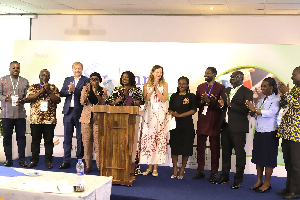
 The dignitaries at the launch of the InnoWaste project
The Chief Director of the Ministry Environment, Science, Technology and Innovation, Suweibatu Adam, has described the InnoWaste project introduced by the German Development Cooperation and its partners as opportune.
According to her, the project will help manage Ghana increasing volumes of plastic waste.
The chief director of the environment ministry said this when she delivered the keynote address at the launch of the InnoWaste Project in Accra on May 28.
The “InnoWaste: Empowering Youth through Innovative Plastic Waste Management Solutions” project seeks to create sustainable economic opportunities for stakeholders across the plastic waste value chain, with a particular focus on women and youth.
By promoting circular economy principles, the initiative will support waste collectors, aggregators, and recyclers to increase their incomes, improve working conditions, and enhance environmental sustainability.
Adam disclosed that “Ghana generates approximately 1 million metric tonnes of plastic waste every year, a figure growing at an estimated 5.4 percent annually, driven by population growth and rising per capita consumption. Yet only about 9.5 percent of that plastic waste is currently collected for recycling,” she revealed.
According to her, “The rest, the overwhelming majority ends up in our drains, rivers, oceans, and our communities, threatening marine ecosystems, agricultural land, public health, and the livelihoods of fishing and farming communities who depend on clean water and healthy soils.”
She expressed worry that, “If we continue this trajectory, plastic leakage into Ghana’s water bodies is projected to grow by 190 percent between 2020 and 2040: from approximately 78,000 tonnes per year to 228,000 tonnes per year. That is not a future we can accept.”
Adam disclosed that research by the Ghana Climate Innovation Centre estimates that Ghana could generate more than GH¢88 million annually simply by recycling its plastic waste.
“This is the opportunity we are here to seize,” she stressed.
The Deputy Minister of Local Government, Chieftaincy and Religious Affairs, Rita Naa Odoley Sowah, who launched the project commended the German Development Cooperation and its partners for introducing a project that aims at turning plastic waste into wealth.
She said the introduction of such a project is not only timely but strategic.
According to Odoley Sowah, this project aligns strongly with both the priorities of the Ministry of Local Government, Chieftaincy and Religious Affairs and the commitments Ghana has made to the international community on circular economy and climate action.
“By targeting plastic waste management, anchoring its work within the local governance systems that our Assemblies operate, and focusing on the livelihoods of women and youth who are disproportionately represented in the informal waste economy, InnoWaste is an intervention that is both timely and strategic,” she said.
The deputy minister noted that, “the InnoWaste partnership embodies the kind of collaboration Government envisions where government leadership, development cooperation and private sector investment converge to solve critical national challenges.”
She further noted that the theme for the launch, “From waste to wealth: Driving a circular future”, speaks directly to one of the most urgent transitions facing Ghana and the African continent.
“That is, seeing waste as resource to be recovered and seizing the opportunity to build socio-economic growth through the circular economy,” she indicated.
In his welcome address, the NIED Cluster Coordinator at Giz, Wilhelm Hugo, said the launch of InnoWaste Project marks the strengthening of a shared commitment to transform one of the country’s greatest environmental challenges into an opportunity for innovation, inclusion, and sustainable growth.
“The InnoWaste project is jointly funded through the develoPPP programme in partnership with Zoomlion Ghana Limited and Blue Skies Products Ghana and implemented by GIZ on behalf of the German Federal Ministry for Economic Cooperation and Development,” he said.
“Through this project, we aim to create green jobs, improve working conditions, expand social protection, and promote dignified and sustainable livelihoods for thousands of Ghanaians,” he stated.
Hugo noted that “This partnership represents what we call a triple win. First, it delivers an environmental win by reducing plastic pollution, promoting recycling, and advancing Ghana’s transition to a circular economy. Second, it creates an economic win by unlocking new business opportunities, strengthening local value chains, and generating decent green jobs. And third, it delivers a social win by improving livelihoods, empowering women and youth, and fostering more inclusive and resilient communities.”

Copyright © 1994 - 2026 GhanaWeb. All rights reserved.










