



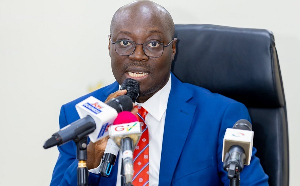
 Dr Cassiel Ato Forson is the Minister of Finance
Minister of Finance, Dr Cassiel Ato Forson, has disclosed that the nation has set a target of adding 3,000 megawatts (MW) of new electricity generation capacity by 2030.
At least 30 percent of the planned capacity is expected to come from renewable energy sources, as government seeks to narrow the growing gap between electricity supply and demand and avert a return to the widespread power outages that affected the economy for more than a decade.
Speaking at the 2026 Ishmael Yamson and Associates Business Roundtable in Accra, he said energy security is the non-negotiable precondition for industrialisation, stating: “We cannot industrialise in darkness. Our goal is to achieve 3,000 megawatts of additional installed capacity by 2030. Of this, 30,000 will be renewables”.
He noted that Africa collectively loses an estimated US$25billion annually to power outages.
The announcement extends a series of energy commitments government has made in recent months, including President John Mahama’s announcement in May of plans to cut the sod this year for a 1,200-megawatt gas-fired power plant – the single largest generation project that has been proposed in many years.
Currently, installed generation capacity is approximately 5,200 megawatts with a total dependable capacity of 4,800 megawatts.
Peak electricity consumption, which stood at approximately 3,500 megawatts when the Mahama administration took office in January 2025, has since risen to about 4,300 megawatts – driven by increased investment and economic activity.
Under a business-as-usual scenario, demand is projected to peak at 6,150 megawatts by 2030. Without new investment, Ghana will exhaust its dependable capacity by 2027 and its installed capacity by 2028.
Analysts have said this trajectory could trigger a return to ‘dumsor’ by that year, even before factoring-in the additional load of government’s 24-hour economy policy.
Should the 24-hour economy programme be implemented at scale – with its 50 industrial parks, agro-ecological zones and digital hubs – peak demand by 2030 could surge to 9,150 megawatts.
The planned 1,200-megawatt gas-fired plant, which the Ministries of Energy and Finance have designed a roadmap for, is intended to stabilise domestic supply, build system redundancy and potentially enable Ghana’s export of surplus power to neighbouring countries, including Burkina Faso.
The facility, described as one that will become Ghana’s largest power plant upon completion, is expected to utilise an additional 150 million standard cubic feet of natural gas per day from the Offshore Cape Three Points partners and Ghana Power Plant 2 project.
It will represent the cornerstone of the 3,000 MW addition target, though a financing structure for the full programme has not been publicly announced.
The distribution infrastructure through which any new generation capacity would flow is itself in a deteriorating condition. In 2024, ECG lost 32 percent of its purchased electricity – the highest in over two decades, generating substantial revenue losses.
Ghana’s energy sector entered 2026 with its international standing partially restored after US$1.47billion in legacy arrears were cleared during 2025, including full replenishment of an exhausted World Bank Partial Risk Guarantee… but the structural crisis persists.
ECG’s debt stands at GH¢68billion, the IMF has flagged a US$2.2billion sector shortfall for 2025 and the cumulative financing gap across 2023–2026 is estimated at GH¢140billion.
Energy Sector Recovery Programme data estimate that power sector shortfalls between 2019 and 2023 alone amounted to approximately US$8.25billion, in contrast to the National Development Planning Commission’s (NDPC’s) 40-year National Infrastructure Plan which had targetted a reduction in distribution losses from 24 percent to 9 percent.
In November 2025, the West African Power Pool achieved a milestone with its first full regional grid synchronisation trial – paving the way for full and permanent synchronisation in 2026 and the establishment of a unified regional electricity market.
Nigeria has announced its intention to begin exporting electricity fot up to 15 West African countries by mid-2026, targetting an additional US$1billion in annual revenue.
In January 2025, the World Bank approved a US$1.6billion multiphase West Africa Regional Electricity Market Programme, with its first phase targetting the Ghana–Côte d’Ivoire interconnection to enhance transmission capacity and facilitate cross-border trade.
For Ghana, these regional developments represent both opportunity and competitive pressure: a country that can generate surplus power and plug effectively into the WAPP market stands to earn significant foreign exchange; one that cannot meet domestic demand is a net importer in a market where the terms of trade are shifting rapidly.
Analysts have estimated that meeting Ghana’s generation and grid needs by 2030 will require approximately US$10billion in investment across capacity expansion, transmission infrastructure improvement and off-grid solutions.
The 3,000 MW target, if achieved exclusively through gas-fired thermal capacity as the 1,200 MW plant suggests, would deepen Ghana’s reliance on a fuel supply chain already under strain.
Thermal generation currently accounts for approximately 70 percent of Ghana’s installed capacity, with the sector heavily dependent on natural gas, oil and diesel.
It is estimated that, if delivered, the 30 percent renewables component of the 3,000 MW target will begin to rebalance a generation mix historically vulnerable to gas supply disruptions.
However, this would require a clear pipeline of projects, firm financing commitments and greater regulatory certainty, following government’s 2020 moratorium on new embedded generation licences that was only partly lifted in 2023.

Copyright © 1994 - 2026 GhanaWeb. All rights reserved.










