



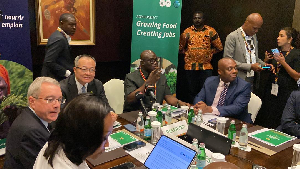
 AGRICONNECT aims to modernise agriculture into agribusiness and boost jobs and economic growth
The Government of Ghana, in partnership with the World Bank and other development partners, has launched the Ghana National Pact for Agriculture and Economic Transformation (AGRICONNECT), a comprehensive agricultural strategy aimed at accelerating agricultural transformation, strengthening food security, expanding agribusiness investment and creating millions of jobs.
The launch, held in Accra on Wednesday, June 3, 2026, brought together government officials, development partners, private sector representatives and stakeholders from across the agricultural value chain.
Speaking at the launch, the Minister of Food and Agriculture, Eric Opoku, said the compact was developed through a collaborative effort involving multiple government ministries with support from the World Bank, the International Fund for Agricultural Development (IFAD), the African Development Bank (AfDB) and other development partners.
According to him, the government identified strategic crops and sectors where Ghana possesses significant competitive advantages and the potential to develop entire value chains that can create jobs, especially for young people.
"We zeroed in on some specific crops where we have enormous potential to develop the entire chains and generate jobs for the youth," Opoku said.
He expressed appreciation to development partners for their commitment to supporting the implementation of what he described as a "game-changing programme" for Ghana's agricultural sector.
Deputy Minister of Finance, Thomas Nyarko Ampem, highlighted the economic urgency of transforming agriculture, noting that Ghana spends between US$2 billion and US$3 billion annually importing food products that could be produced competitively within the country.
"These represent jobs exported, factories never built, value chains left undeveloped and foreign exchange unnecessarily drained," he said.
Ampem stressed that agriculture remains central to Ghana's economic transformation agenda, contributing approximately 22 percent of Gross Domestic Product (GDP), accounting for about 24 percent of export earnings, and providing livelihoods for nearly 38 percent of the national workforce.
He noted that when the broader agrifood system is considered, it supports almost 44 percent of employment nationwide.
The Deputy Finance Minister outlined several government interventions aimed at modernising agriculture, including the Feed Ghana Programme, the Grow24 Initiative under the 24-Hour Economy Policy, the Big Push infrastructure programme, and broader agro-industrialisation efforts.
He disclosed that the Ministry of Finance has released GH¢1.677 billion, representing 85 percent of the approved budget for goods, services and capital expenditure for the Ministry of Food and Agriculture.
The funds include GH¢581.4 million for the establishment of 50 Farmer Service Centres, GH¢110 million for irrigation infrastructure, GH¢515.3 million for fertiliser and certified seed distribution, GH¢244.9 million for the Poultry Farm-to-Table Project, and GH¢200 million for the National Food Buffer Stock Company.
Ampem also highlighted the government's partnership with the World Bank on the US$523 million Ghana Market Access and Connectivity (GMAC) Project, which will rehabilitate approximately 1,000 kilometres of feeder roads in major food-producing areas to improve market access, reduce post-harvest losses, and increase farmer incomes.
World Bank Vice President for Planet Practice Group, Guangzhe Chen, described AGRICONNECT as a platform for creating both more jobs and better jobs through stronger linkages between agricultural production, processing, logistics and markets.
He said the compact would focus on six scalable solutions, including agricultural technology and digital tools, investment in roads and irrigation infrastructure, improved extension services and research, enhanced access to finance and agricultural insurance and policy reforms to create an enabling environment for investment.
Chen revealed that the compact is backed by a proposed US$3.5 billion investment programme over the next five years, supported by the Government of Ghana, the World Bank Group, the African Development Bank, IFAD and other development partners.
"This effort reflects the power of partnership," he said, adding that the World Bank would continue supporting Ghana through financing, technical expertise, knowledge sharing and private sector mobilisation.
World Bank Division Director for Ghana, Liberia and Sierra Leone, Robert Taliercio, noted that Ghana's compact stands out because of its clear priorities and strong reform agenda.
He said the strategy focuses on high-potential sectors where Ghana has strong competitive advantages and where opportunities for job creation and import substitution are substantial.
According to him, the compact adopts a systems approach that includes expanding irrigation and mechanisation, improving feeder road infrastructure, promoting climate-smart agriculture, strengthening digital agricultural services and building farmer irrigation systems expected to benefit more than 3.5 million farmers.
Taliercio observed that while Ghana's agro-processing sector has recorded growth in recent years, the country continues to lose significant value through imports.
He cited government data showing that domestic poultry production currently meets only about five percent of national consumption.
He said the challenge facing Ghana is how to convert its food import bill into local production, employment, and food security gains.
AGRICONNECT is a national compact designed to transform agriculture into a modern agribusiness sector by focusing on key value chains with significant potential for economic growth and employment generation.
The initiative prioritises cocoa, oil palm, rice, maize and poultry, while also recognising opportunities in cashew, coconut, rubber, fisheries, horticulture, and the forest economy.
The initiative will be implemented under a results-based framework with measurable targets covering productivity, job creation, food security and value-chain performance.
Meanwhile, watch as Ghana's Parliament passes anti-LGBTQ bill again:

Copyright © 1994 - 2026 GhanaWeb. All rights reserved.










