



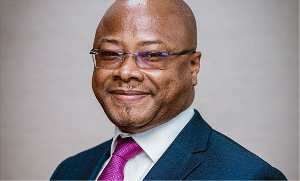
 Michael Edem Akafia is the former president of the Ghana Chamber of Mines
The Immediate Past President of the Ghana Chamber of Mines, Michael Edem Akafia, has stated that Ghana's mining sector remained the country's largest contributor to direct domestic revenue in 2025, despite facing rising operational costs, policy uncertainties and illegal mining activities.
Speaking at the 98th Annual General Meeting of the Ghana Chamber of Mines on June 5, 2026, Akafia highlighted the sector's significant contribution to economic growth, export earnings, employment and government revenue.
According to him, the industry continued to play a pivotal role in Ghana's economic performance, helping the country record its strongest growth in five years.
"The sector remains the country's largest source of direct domestic revenue, its leading source of merchandise export earnings, a vital contributor to foreign exchange reserves, and a significant driver of employment, local procurement, and community investment," Akafia said.
He also noted that attributable gold production increased by 23.41 percent from 4.82 million ounces in 2024 to 5.94 million ounces in 2025, with small-scale mining accounting for the majority of the output.
"Small-scale mining accounted for 52.4 per cent of national output, overtaking large-scale producers for the first time in more than a century," he revealed.
Akafia explained that the mining and quarrying sector remained the largest contributor to direct domestic revenue mobilised by the Ghana Revenue Authority, with taxes attributable to the sector rising from GH¢20.87 billion in 2024 to GH¢23.11 billion in 2025.
He added that mineral export receipts also witnessed a sharp increase during the period, rising from US$11.98 billion to US$21.36 billion and accounting for more than two-thirds of Ghana's gross merchandise exports.
He further expressed concerns about recent revisions to the country's mining fiscal regime, warning that they could affect the sector's competitiveness and attractiveness to investors.
"When combined with corporate income tax, the State's free carried interest, and other statutory imposts, the revised regime raises the overall tax burden on mining to an estimated 54 per cent to 58 per cent. This places Ghana among jurisdictions with the highest effective tax burdens on mining globally," he stated.
He subsequently called on government to reconsider the current tax structure.
"The Chamber therefore urges Government to undertake a holistic review of the mining fiscal regime," Akafia stressed.
However, he argued that many host communities had yet to experience development commensurate with the wealth generated from mineral resources.
"The state of many mining communities remains inconsistent with the sector's role as Ghana's largest contributor to direct domestic revenue," he observed.
Akafia reiterated the Chamber's long-standing proposal for a greater share of mineral royalties to be directed towards community development.
"The Chamber reiterates its call for at least 30 per cent of mineral royalties to be returned directly to mining communities," he said.
He further expressed concerns about delays in mining lease renewals, warning that uncertainty surrounding the process could undermine investor confidence and long-term planning.
"Consistent, transparent, and timely application of renewal processes is critical to preserving investor confidence and Ghana's competitiveness," he noted.
On the issue of illegal mining, Akafia described the menace as a major threat to the environment and the sustainability of the industry.
"Illegal mining continues to cause land degradation, water pollution, forest destruction, social tensions, concession encroachment, operational disruptions, security costs, and reputational damage," he said.
Reflecting on his two-year tenure as President of the Chamber, he underscored the importance of collaboration among key stakeholders in ensuring the long-term growth of the mining industry.
"One lesson stands above all others: sustainable progress depends on collaboration among government, industry, communities, and regulators," he stated.
However, he acknowledged that significant challenges remain and called for collective efforts to ensure Ghana's mineral wealth translates into tangible benefits for citizens and host communities.
ANAS/SA
ITAS Rollout: GRA to link 15 government agencies to improve tax compliance

Copyright © 1994 - 2026 GhanaWeb. All rights reserved.










