



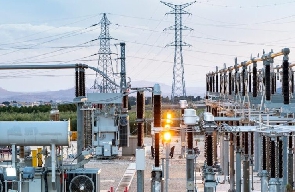
 GH¢5.3 billion of the total amount has been used to clear legacy government arrears
Finance Minister, Dr Cassiel Ato Forson, has announced that the Government has paid GH¢12.4 billion into Ghana’s energy sector and secured more than US$3.5 billion in new upstream oil and gas investment commitments as part of measures to strengthen the country’s energy industry.
Presenting the 2026 Mid-Year Budget Review and Supplementary Estimates in Parliament, Dr Forson said the government had paid GH¢7.1 billion to the energy sector to ensure stable electricity supply across the country, while GH¢5.3 billion had been used to clear legacy government arrears.
The minister made the announcement while updating Parliament on the implementation of government’s key policy initiatives during the first half of 2026.
Upstream Oil and Gas Sector
Dr Forson told Parliament that Ghana’s crude oil production had declined sharply from 71.4 million barrels in 2019 to about 36 million barrels in 2025.
He said the government had introduced investor-friendly reforms to reverse the decline, adding that the reforms had already secured more than US$3.5 billion in new investment commitments from the Jubilee and Offshore Cape Three Points (OCTP) partners.
According to the Finance Minister, the reforms are already producing results.
He said oil production had exceeded expectations, with output from the Jubilee Field increasing from a projected 68,000 barrels per day to about 95,000 barrels per day, while the Sankofa Field is now producing about 28,000 barrels per day.
Dr Forson also announced that gas production had increased from 245 million to about 282 million standard cubic feet per day.
He said a new agreement with the OCTP partners would further increase gas production to 350 million standard cubic feet per day.
The minister further disclosed that the government is updating the laws governing Ghana’s upstream petroleum sector to make the country more attractive to investors.
He said the proposed amendments are expected to be submitted to Parliament before the end of the year.
Gas-to-Power Strategy
Dr Forson said the government remains committed to its Gas-to-Power Strategy, which seeks to replace expensive light crude oil with cleaner and cheaper natural gas.
According to him, the transition is expected to reduce electricity generation costs by at least 75 percent.
He reported that by the end of June 2026, the government had increased gas supply for power generation by an additional 35 million standard cubic feet per day, bringing total supply to about 490 million standard cubic feet per day.
The increase, he said, comprises 10 million standard cubic feet per day from the OCTP partners led by Eni and 25 million standard cubic feet per day from N-Gas.
Dr. Forson told Parliament that replacing light crude oil with natural gas had enabled the government to save GH¢3.08 billion, equivalent to US$268.5 million, in fuel costs during the first half of 2026.
Integrated Ghana Gas Processing Facility
The Finance Minister also announced that the government, in partnership with the private sector, is developing a 100 million standard cubic feet per day modular gas processing facility.
He said land acquisition had been completed, while environmental assessments, engineering design, financial due diligence and project structuring were underway.
According to him, the project will be submitted to Parliament for consideration, with financial close expected before the end of 2026.
Dr Forson said the project is expected to create nearly 1,000 jobs and generate about US$2 billion in benefits to the State over the next five years through fuel savings, foreign exchange savings, taxes, levies and dividends.
1,200-Megawatt State-Owned Power Plant
The Finance Minister further announced that the government is developing a 1,200-megawatt state-owned combined-cycle gas-fired power plant at Kafodzidzi-Abrobeano in the Komenda-Edina-Eguafo-Abrem Municipality.
He said feasibility studies had confirmed the project’s viability, while environmental, engineering and permitting processes were progressing steadily.
According to Dr Forson, the first 600-megawatt phase of the project is expected to be commissioned in 2028.
He also disclosed that the government had secured the gas turbines directly from GE Vernova, achieving savings of between 35 and 45 percent compared with third-party procurement.
The minister said the project is expected to lower electricity generation costs, help reduce electricity tariffs by 10 to 20 percent, and create more than 2,000 direct and indirect jobs during the first phase.

Copyright © 1994 - 2026 GhanaWeb. All rights reserved.










