



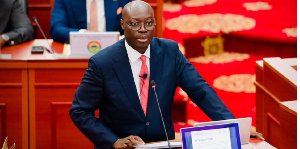
 Dr Cassiel Ato Forson is the Finance Minister
The government has channelled GH¢6.76billion into key education programmes in the first half of 2026, reinforcing its commitment to expanding access to education, improving school infrastructure and reducing the financial burden on students and their families.
Presenting the 2026 Mid-Year Budget Review to parliament, Finance Minister Dr. Cassiel Ato Forson said the funding supports the government's broader education reform agenda, including eliminating the double-track system, strengthening Science, Technology, Engineering and Mathematics (STEM) education and widening access from basic to tertiary level.
Actual releases
The mid-year review showed that GH¢6.76billion has already been released to support major education interventions, indicating implementation of government's commitments.
According to the finance minister, GH¢4.2billion has been transferred to the Ghana Education Trust Fund (GETFund), GH¢1.8billion released to support the Free Senior High School programme, GH¢537million disbursed under the No Fees Stress initiative, GH¢104million paid as Teacher Trainee Allowances, GH¢76million allocated for the Capitation Grant and GH¢46million used to finance BECE registration fees.
Unlike the main budget statement, these figures represent actual disbursements rather than planned allocations - providing a clearer indication of progress in implementing the government's education agenda.
The minister also highlighted that these reforms are backed by a US$ 300 million World Bank-supported programme, which will finance 210 major education infrastructure projects comprising construction of 10 new senior high schools across 10 regions and rehabilitation of 150 existing schools to expand capacity.
He added that government will also absorb examination fees for nearly 900,000 BECE candidates, double feeding grants for special schools, cover first-year tuition for more than 165,000 tertiary students under the No Fees Stress initiative and continue providing full support for students with disabilities.
Ending double-track
Government said expanding school infrastructure remains central in its plan to eliminate the double-track system by creating sufficient capacity for senior high schools.
To address growing demand for high-performing schools, government will also upgrade 30 Category C schools to Category B and 20 Category B schools to Category A, with investments in classrooms, dormitories, laboratories and other critical facilities.
STEM and skills development
Beyond infrastructure, the reforms place renewed emphasis on improving STEM education, increasing female participation in Technical and Vocational Education and Training (TVET) and equipping students with digital and green economy skills needed for the future labour market.
Support for persons with disabilities
The finance minister also highlighted that the government has expanded assistance for persons with disabilities, noting that full tuition and residential support has been allocated for 1,554 students with disabilities enrolled in public tertiary institutions.

Copyright © 1994 - 2026 GhanaWeb. All rights reserved.










