



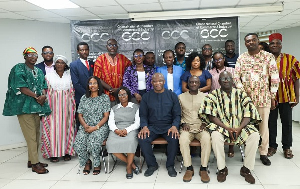
 The project is being implemented by Presbyterian University and GNCCI
The Green Growth Ghana Project is seeking to equip young people and women with skills in waste management, renewable energy and sustainable agriculture to create jobs while protecting the environment.
Chris Adinayo, Project Team Leader for the Green Growth Ghana Project, said that the initiative seeks to leverage Ghana's international environmental commitments to promote sustainable economic opportunities within local communities.
The project is being implemented by the Presbyterian University of Ghana and the Ghana National Chamber of Commerce and Industry (GNCCI), with technical and financial support from the European Union Delegation in Ghana.
Speaking during an engagement on the project in Accra on July 29, 2026, Adinayo said Ghana faces several environmental challenges, including flooding and illegal mining, which require sustainable solutions that also create economic opportunities for local communities.
He said the project was also focused on enhancing the skills of young people and women to enable them to take advantage of opportunities in the green economy.
According to him, skills in areas such as waste management, renewable energy and sustainable agricultural practices could help create jobs while contributing to environmental protection.
"As a country, we face a number of environmental challenges within our communities. We've seen the challenges that we have with the floods. We've seen the challenges that we have, especially with the issue of illegal mining within our local communities," he said.
"This all has the potential of creating new jobs for our women and youth at the same time, helping to protect our environment," he said.
Adinayo further highlighted the important role of the private sector in promoting green economic activities, noting that the GNCCI had been engaging rural communities in the northern regions to better understand their environmental challenges.
He said the Chamber was also exploring ways to support small and medium-sized enterprises (SMEs) and cooperatives to become more competitive in the production of environmentally friendly products.
"The GNCCI have gone into the rural communities in the northern region, understanding better the issues to do with the environment and the challenges, and also exploring ways by which it can support SMEs and cooperatives to be more competitive in the area of environmental products," he said.
He added that the project was working with women, cooperatives and vocational institutions to build their capacity and strengthen collaboration between the private sector and technical and vocational education institutions.
Adinayo said government also had a crucial role to play, particularly in ensuring that international environmental agreements signed by Ghana were effectively implemented at the local level.
"Government has a very important role because government is the main policymaker, and we are looking to engage government more to ensure that the agreements that it has signed at international level, international conventions on environment, those agreements with the support of the local authorities, can be implemented locally," he said.
Adinayo identified access to finance as one of the major challenges facing businesses operating in the green economy.
He explained that many of the businesses and sectors targeted by the project required alternative forms of financing because conventional commercial bank financing was not always suitable for their operations.
He said the project had therefore engaged the Kwame Nkrumah University of Science and Technology (KNUST), through Professor Datson, to explore alternative sources of financing for SMEs and cooperatives.
According to him, the objective was to identify funding models that prioritise social and environmental outcomes rather than being solely profit-oriented.
"We are quite happy to say we have engaged the Kwame Nkrumah University of Science and Technology, in the person of Professor Datson, who is engaging with these stakeholders and SMEs to explore alternative sources of funding," he said.
Adinayo expressed optimism that access to such alternative financing would enable businesses operating in the green economy to become more competitive, create jobs and develop sustainable businesses.
He said supporting SMEs and cooperatives to produce sustainable products could ultimately contribute to job creation, poverty reduction and environmental protection.
BAI

Copyright © 1994 - 2026 GhanaWeb. All rights reserved.










