



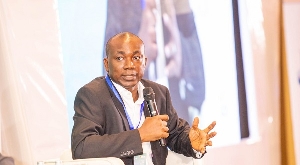
 Professor Godfred Bokpin is an economist
Economist Godfred Bokpin has cautioned that Ghana's aggressive fiscal consolidation under the IMF-supported programme may have restored macroeconomic stability faster than expected, but at the cost of the country's long-term economic growth and productivity.
Speaking at the CEO Webinar Hub on July 31, 2026, he said that while the government has highlighted interest savings and improvements in key macroeconomic indicators, those gains have come alongside significant losses to public institutions and severe cuts in productive spending.
“The austerity was quite severe,” he said.
He explained that the government adopted expenditure-based fiscal consolidation, complemented by tight monetary policy, to restore macroeconomic stability within a shorter period.
Don't be afraid to spend, invest in growth - Professor Bokpin tells government
“When you adopt expenditure-based fiscal consolidation as a path to choose, and you complement that with a huge sterilisation of monetary tightening, it has its own side effects. Sometimes you will see the gains in the short term, but in the medium to the long term, you'll be compromising the survivability of the economy,” he said.
He noted that although the original IMF-supported programme, approved in 2023, envisaged restoring debt sustainability by 2028, the government accelerated the process by targeting a primary surplus of 1.5% of GDP in 2025.
“People are celebrating the fact that we have restored debt sustainability two years ahead of schedule. But what we should bear in mind is the forgotten expenditure, which is critical for easing the restrictions on the growth drivers of the economy,” he stated.
He argued that because government revenues did not expand as expected, the authorities relied heavily on expenditure cuts instead of additional borrowing.
According to him, while compensation for public sector workers increased by about 13%, spending on goods and services was slashed by more than 47%.
“Government was on track with payment for salaries and all of that, but government had to cut expenditure on the use of goods and services by more than 47%. People went to work, they took their salaries all right, but when it comes to the tools to work with, goods and services, we've cut that significantly. You are paying salaries, but productivity is going to suffer,” he said.
TOR paid in full for Ghana's Jubilee crude - President Mahama
He maintained that the original IMF programme's gradual approach would have preserved room for critical investments while pursuing fiscal discipline.
He stressed that while restoring macroeconomic stability is important, Ghana must ensure that fiscal adjustment does not come at the expense of investments needed to sustain long-term economic growth.
DR/MA

Copyright © 1994 - 2026 GhanaWeb. All rights reserved.










