



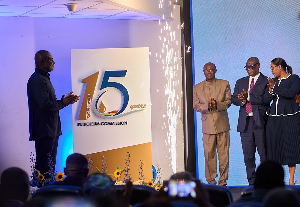
 According to the Minister, the investment will finance the drilling of at least 10 new wells
The Jubilee and TEN field partners have committed US$2 billion towards further development activities aimed at increasing oil and gas production, Minister for Energy and Green Transition Dr John Abdulai Jinapor has disclosed.
According to the Minister, the investment will finance the drilling of at least 10 new wells, increase gas production and reduce the price of Jubilee gas by approximately 18 percent.
He said the expected reduction in gas prices would save Ghana nearly US$300 million in power generation costs.
Dr Jinapor made the disclosure in Accra on Tuesday, August 18, 2026, at the launch of the Petroleum Commission’s 15th anniversary celebrations.
Petroleum Commission saved Ghana $2 billion through oil project reviews – CEO
“As a testament to the ‘reset’ in investor confidence, the Jubilee and TEN Partners have committed US$2 billion in further development activities,” he said.
He added that the Plan of Development for the project had already been approved by the Ministry of Energy and Green Transition.
The Minister also disclosed that the Offshore Cape Three Points partners; Eni, Vitol and the Ghana National Petroleum Corporation (GNPC), had pledged US$1.5 billion to expand gas exports and develop new discoveries.
He said the investment, contained in a Memorandum of Intent, would increase gas exports from 270 million standard cubic feet per day (MMscf/d) to 350 MMscf/d.
The partners would also support the development of the Eban-Akoma discoveries and two new exploration ventures.
Dr Jinapor said the investments reflected growing confidence in Ghana’s upstream petroleum sector following measures taken by government to resolve outstanding disputes between the state and upstream operators.
“For the first time in the history of the upstream sector, nearly all super majors have expressed interest in acquiring acreages in our geological basins, in particular the frontier areas,” he said.
He added that petroleum agreement negotiations had commenced with some of the companies, with new deals expected to be announced in the coming weeks.
The Minister said government was reviewing Ghana’s petroleum policy, legislative and regulatory framework to attract new investment while ensuring a fair return to the state.
He said a committee established to undertake the review had submitted its initial report, which had been accepted following further engagements and was due for Cabinet consideration and approval.
According to Dr Jinapor, Ghana must compete on certainty as global energy markets become increasingly volatile.
“The new question is: ‘Where can capital be deployed with confidence?’” he said.
He identified fiscal stability, sanctity of contracts and predictability in laws and regulations as critical to attracting investment into the upstream sector.
Dr Jinapor also announced plans to develop a Second Gas Processing Plant (GPP II) as part of efforts to strengthen Ghana’s gas-to-power infrastructure.
The plant is expected to have an initial processing capacity of 150 MMscf/d, expandable to 300 MMscf/d, to process additional gas from the Greater Jubilee and TEN fields as well as future discoveries.
According to the Minister, a joint assessment by the Ministry of Finance and the Ministry of Energy and Green Transition indicates that GPP II could save Ghana close to US$500 million every two years.
He said the project would provide a cleaner and more affordable fuel source for power generation while supporting industrial development and creating jobs.
Jinapor also commended the Petroleum Commission for its contribution to the regulation and development of Ghana’s upstream petroleum industry over the past 15 years.
He said the establishment of the Commission under the Petroleum Commission Act, 2011 (Act 821), separated the regulatory function from the commercial activities of GNPC.
The Minister said the Commission had since developed into a first-rate regulator and played a significant role in promoting local content.
He noted that at the end of 2013, Indigenous Ghanaian Companies had received contracts worth US$146 million, while joint venture companies involving Ghanaian businesses had received US$43 million.
By the first half of 2026, however, nearly US$5 billion out of total upstream contracts worth US$22.3 billion had gone to Indigenous Ghanaian Companies, while US$7.9 billion had gone to joint ventures involving Ghanaian companies.
Dr Jinapor said the figures demonstrated the impact of Ghana’s local content policy and the Petroleum Commission’s regulatory oversight.
MA

Copyright © 1994 - 2026 GhanaWeb. All rights reserved.










