



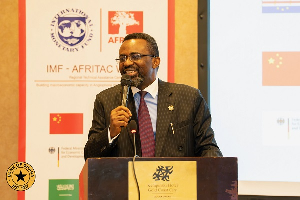
 BoG Governor, Dr Johnson Pandit Asiama
The Bank of Ghana (BoG) has moved away from a consensus-based approach to monetary policy decisions in favour of majority voting as part of reforms to improve transparency, accountability and credibility.
Governor of the BoG, Dr Johnson Pandit Asiama, said the reform, introduced in March 2025, allows members of the Monetary Policy Committee (MPC) to express their individual views and reasoning behind their preferred policy decisions.
He said the Bank now publishes individual decision statements from MPC members to give the public greater insight into the considerations behind monetary policy decisions.
How classroom economics comes to life in Ghana’s monetary policy decisions
Dr Asiama disclosed this at a High-Level Forum on the Modernisation of Monetary Policy Formulation and Implementation at the Kempinski Gold Coast Hotel in Accra on Monday, August 17, 2026.
“Since March 2025, we have transitioned away from a consensus-building approach to a majority-vote decision process, aligning our practices with those of other major inflation-targeting central banks,” he said.
“We now publish individual decision statements of each MPC member - submissions that clearly articulate the data-driven reasoning underlying their preferred policy direction.”
According to him, the reform was intended to demonstrate that monetary policy decisions are based on rigorous economic analysis.
“This reform moves us from ‘behind closed doors’ decision-making to a more transparent, data-driven process that builds credibility by showing the public that our decisions are not arbitrary but grounded in rigorous economic analysis,” he said.
Dr Asiama also highlighted reforms to the Bank’s monetary policy communication strategy, stressing that communication is an integral part of monetary policy.
“Communication is not something that happens after monetary policy. It is indeed part of monetary policy,” he said.
He said the Bank had also conducted post-MPC regional media engagements and workshops to improve financial journalists’ understanding of monetary policy and help curb misinformation and disinformation.
The Governor said the Bank had reintroduced the 14-day bill as its main instrument for conducting open market operations to improve market functioning and strengthen monetary policy transmission.
The Bank has also introduced a new Foreign Exchange Operations Framework to provide a transparent and rules-based approach to foreign exchange operations.
Dr Asiama said the framework clarifies the objectives of interventions, supports reserve accumulation and helps reduce excessive exchange-rate volatility while maintaining a flexible, market-determined exchange rate.
The Governor said the Bank was using technology and high-frequency data to identify emerging inflationary pressures more quickly.
He cited the Bank’s e-inflation measure, which is calculated almost in real time.
“These tools allow us to identify emerging trends more quickly and assess the underlying risks to the inflation outlook,” he said.
Dr Asiama also noted that stablecoins were creating new challenges for central banks.
“Stablecoins, for example, raise important questions for payments, financial stability, monetary sovereignty and potentially monetary transmission,” he said.
The Governor further said amendments to the Bank of Ghana Act had strengthened central bank independence, formalised MPC processes and reinforced limits on monetary financing of the budget.
“Modernisation is therefore institutional as much as it is analytical or technological,” he said.
MA

Copyright © 1994 - 2026 GhanaWeb. All rights reserved.










