



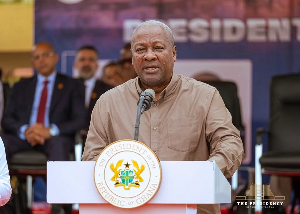
 President John Dramani Mahama
Three major investment programmes are expected to account for about 95% of the 800,000 jobs targeted under the 2026 Budget, placing road construction, commercial oil palm development and garment manufacturing at the centre of the government’s employment drive.
The three interventions are projected to generate at least 760,000 jobs, comprising 490,000 from infrastructure projects under the Big Push programme, more than 250,000 from the Integrated Oil Palm Development Programme and over 20,000 direct jobs from three garment factories.
The Big Push programme carries the largest share, with the government projecting about 490,000 jobs from road and related infrastructure projects.
The government has committed substantial resources to the programme, which covers trunk, urban and feeder roads, bridges and other transport infrastructure across the country. The employment projection extends beyond workers directly engaged on construction sites to activities across the wider construction supply chain.
The Big Push alone accounts for about 61% of the government’s headline job target.
Oil palm development provides the second-largest employment block.
The government is pursuing a US$500 million financing programme to support large-scale commercial plantations, outgrower schemes, processing and other investments across the oil palm value chain.
The programme is expected to establish about 100,000 hectares of commercial oil palm plantations, with the government assembling land banks to attract private investment into production and processing.
The 2026 Budget projects that the intervention could generate more than 250,000 direct and indirect jobs, equivalent to roughly 31% of the overall employment target.
Together, the Big Push and oil palm programmes therefore account for a projected 740,000 jobs, or more than nine out of every 10 jobs contained in the headline target.
The third major component is garment manufacturing, where the government expects three factories to provide more than 20,000 direct jobs.
The government is intensifying efforts to expand labour-intensive manufacturing and increase production under the 24-Hour Economy Programme, with textiles and garments among the sectors being positioned for additional investment and export production.
Other initiatives contained in the Budget are expected to contribute to employment outside the three major programmes. These include agro-processing plants, Farmer Service Centres, apprenticeship schemes and financing interventions targeting small businesses.
The latest Ghana Statistical Service data put the national unemployment rate at about 13%, while the 2021 Population and Housing Census showed unemployment rates of 19.7% among people aged 15 to 35 and 32.8% among those aged 15 to 24.
The economy expanded by 6.4% in the first quarter of 2026, according to the latest GSS data, extending the stronger growth recorded over the past year.
The employment projections, however, cover different categories of jobs and should therefore not all be treated as 760,000 new permanent positions.
The oil palm estimate includes direct and indirect employment, while the garment projection refers to direct jobs. Employment associated with road construction also extends across contractors and the wider construction value chain.
This distinction means the actual employment generated by the programmes will depend on the scale and pace of project execution, the use of local labour and inputs, and the progression of the oil palm programme from financing and land preparation to commercial production.
With the Big Push accounting for about 61% of the target and oil palm another 31%, infrastructure and agriculture together carry most of the government’s 2026 employment programme.
The figures effectively put 740,000 of the targeted 800,000 jobs on two investment programmes, making the pace of road construction and commercial oil palm development central to the government’s employment outturn.

Copyright © 1994 - 2026 GhanaWeb. All rights reserved.










