



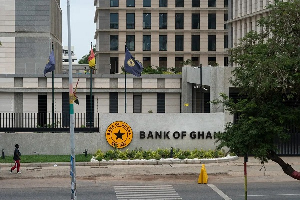
 The Bank of Ghana headquarters
The Bank of Ghana (BoG) and The Apex Bank, formerly ARB Apex Bank PLC, are considering individual declarations submitted six weeks ago by Ghana’s community banks regarding their recapitalisation or merger plans.
The process involves an ongoing regulatory review by the BoG and The Apex Bank to assess the financial viability of each bank’s standalone proposal and the structural rationale behind proposed mergers.
Under the BoG’s Guideline on the Revised Microfinance Sector Framework, 2026, struggling banks that are unable to meet the new GH¢5 million or GH¢10 million minimum capital requirements have structured legal pathways to combine operations, pool assets or face an orderly exit.
Capital-deficient banks were required to formally declare their intended pathway — standalone compliance, consolidation or asset transfer — to the BoG by June 30, 2026.
This was the first of three deadlines for the process. The next is September 30, 2026, by which time merging institutions must submit a binding progress update on their consolidation agreements, legal audits and joint capitalisation status.
The final deadline is December 31, 2026, by which time all community banks, whether through mergers or recapitalisation, must be fully integrated, capitalised to at least GH¢5 million or GH¢10 million — depending on which of the two institutional categories they fall under — and complete all required corporate name changes.
However, the BoG has not yet publicly released an aggregate breakdown showing how many community banks have opted for standalone compliance and how many have chosen to merge.
Although the initial legal deadline for institutions to declare their chosen pathway passed on June 30, the central bank is handling the early filings confidentially to prevent speculative panic or sudden deposit runs at undercapitalised institutions.
Public statements from the Association of Rural Banks (ARB), however, indicate that a significant proportion of the approximately 145 newly transitioned community banks face major challenges in raising their capital from the legacy GH¢1 million level to the new GH¢5 million or GH¢10 million minimum.
Consequently, industry analysts expect a substantial wave of consolidation, particularly among smaller single-branch banks operating within the same geographical areas, to avoid forced asset transfers or regulatory sanctions.
The official list of institutions that have achieved standalone compliance and those approved for mergers is expected to be finalised after the September 30, 2026 progress update deadline, once the BoG has reviewed and either approved or rejected the proposed merger frameworks.
Two capital thresholds
Under the Guideline on the Revised Microfinance Sector Framework, 2026, the BoG differentiates between the two capital requirements based on institutional origin, operational location and entry category.
The higher GH¢10 million requirement applies primarily to newly established institutions seeking licences to operate in urban areas after the framework’s enactment, as well as existing urban community banks operating in highly competitive environments alongside commercial and microfinance banks.
The BoG requires the higher capital buffer to help institutions absorb the higher operational costs, liquidity demands and credit risks associated with urban commerce.
The GH¢5 million baseline, meanwhile, represents an escalation path designed to strengthen existing, previously licensed rural banks.
While standard community banks focus heavily on localised deposit-taking, urban institutions generally manage higher transaction volumes. The higher capital tier is therefore intended to provide greater resilience against financial stress within urban clearing networks managed by The Apex Bank.
Regardless of whether a bank falls under the GH¢5 million or GH¢10 million capital threshold, however, the BoG will enforce the same governance requirements across both categories.
Both types of institutions must maintain at least 30% local share ownership by individuals or groups within their respective areas of operation to ensure community participation.
They must also fully meet their required capital levels and complete all statutory name changes by December 31, 2026.
Merger requirements
The BoG’s framework allows two or more transitioning community banks to legally pool their stated capital, balance sheets and operations to collectively meet the GH¢5 million minimum capital requirement.
However, no merger, acquisition or asset combination can be legally completed without the prior written approval of the Bank of Ghana.
All integration procedures must also comply with the Banks and Specialised Deposit-Taking Institutions Act, 2016 (Act 930), to ensure structural legality and financial soundness.
The primary regulatory condition for merger approval is the protection of customer deposits.
The BoG also requires funds to be transferred smoothly without loss. Merging banks must publish clear and prominent legal notices in local newspapers and directly notify customers before executing asset migrations or closing redundant branches.
In addition, merger plans must include clear business continuity protocols to ensure that online banking, ATM services and over-the-counter transactions remain uninterrupted during the transition.
Consequences of non-compliance
If a struggling bank fails to secure a merger agreement or inject sufficient fresh capital before the December 31, 2026 deadline, the Bank of Ghana is expected to take strict regulatory action.
Possible measures include immediate restrictions on lending, expansion and dividend payments, as well as the forced transfer of the bank’s performing loans and customer deposits to a stable, well-capitalised community bank.
Ultimately, the bank could have its licence revoked under a controlled exit arrangement designed to protect remaining depositors and preserve financial stability.

Copyright © 1994 - 2026 GhanaWeb. All rights reserved.










