



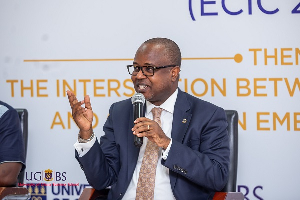
 Dr Maxwell Opoku-Afari is a former Bank of Ghana First Deputy Governor
Ghana’s 2022 debt crisis was not a sudden economic shock but the result of vulnerabilities that had accumulated over more than a decade, former Bank of Ghana First Deputy Governor Dr Maxwell Opoku-Afari has said.
In a policy note titled “How Not to Miss a Crisis: Lessons from Ghana,” Dr Opoku-Afari argues that several warning signs of the eventual crisis were visible years before Ghana suspended payments on most of its external debt in December 2022.
According to the report, the country’s vulnerabilities were reflected in persistent fiscal deficits, rising interest payments, weak international reserves, currency pressures, and mounting liabilities in the energy, cocoa, and financial sectors.
We have no control over 24-Hour Economy markets – Goosie Tanoh clarifies
“Ghana’s 2022 debt crisis was not a sudden accident; it was the predictable outcome of a prolonged accumulation of fiscal, macro-financial, and public-sector balance-sheet vulnerabilities,” the report said.
The paper notes that Ghana’s public debt increased from about 38.9% of GDP in 2010 to 92.7% in 2022.
Dr Opoku-Afari further argues that the country’s relatively strong economic growth in the decade preceding the crisis helped mask underlying weaknesses in the economy.
Between 2010 and 2019, Ghana recorded average GDP growth of 6.7%, while per capita GDP growth averaged 4.2%.
However, he notes that this growth was largely driven by commodities and extractive activities rather than broad-based productivity improvements.
“Strong headline growth, largely commodity and extractives-led, masked low productivity, limited diversification, and ‘jobs-lite’ outcomes,” the report said.
The policy note also highlights Ghana’s repeated reliance on borrowing to finance budgetary gaps, resulting in interest payments consuming an increasing share of government resources.
Between 2018 and 2022, interest payments accounted for about 29% of total government expenditure on average, while interest payments and compensation of employees together consumed nearly 60% of the budget.
Dr Opoku-Afari believes that the scale of these pressures should have triggered corrective measures much earlier.
He says the experience offers an important lesson for policymakers; identifying economic risks is not enough if the warnings do not lead to timely action.
“Ghana’s experience shows that the warning signs can be visible long before the crisis. The policy challenge is to ensure that they trigger action while adjustment remains a choice,” the report concluded.
MA
Noise Maker, Palm Wine Bar Talk, Prison in His Brain: Sammy Gyamfi tears into Afenyo-Markin

Copyright © 1994 - 2026 GhanaWeb. All rights reserved.










