



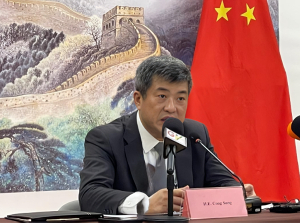
 Cong Song is the Chinese Ambassador to Ghana
Ghana is expected to gain greater access to the Chinese market following China’s decision to grant zero-tariff treatment to products from 53 African countries with which it has diplomatic relations.
The policy, which took effect on May 1, 2026, is expected to boost Ghanaian exports, attract investment, promote local processing and deepen trade and economic cooperation between the two countries.
At a Ghana-China Zero-Tariff Policy Roundtable in Accra, China’s Ambassador to Ghana, Cong Song, outlined the policy through three “As” — Access, Alignment and Advocacy — as stakeholders explored how Ghana can maximise the opportunities presented by the initiative.
According to data from China’s General Administration of Customs, bilateral trade between Ghana and China reached a record US$14.12 billion in 2025, with Ghana’s exports to China reaching US$2.67 billion, representing a 33.9 per cent year-on-year increase.
Ambassador Cong Song said the positive trend had continued following the implementation of the zero-tariff policy, with China’s imports from Ghana reaching US$290 million in June 2026 — a 6.1 per cent year-on-year increase and a 166 per cent month-on-month rise.
He said June’s imports accounted for 27 per cent of China’s total imports from Ghana in the first half of 2026.
Trade Minister targets $12 billion investments for job creation
Explaining the first “A”, Access, Ambassador Cong Song said zero tariffs would reduce the cost of African products entering China and improve their competitiveness.
He cited Ghanaian cocoa, which previously attracted tariffs of between 8 and 22 per cent, as an example of a product that could benefit from the new arrangement.
Other products identified as having export potential include cocoa products, cashew kernels, shea butter, textiles, handicrafts, pineapples, mangoes and coconuts.
The second “A”, Alignment, focuses on linking increased market access with industrial development.
Ambassador Cong Song said capital and intermediate goods account for about 75 per cent of China’s exports to Africa, providing important inputs for industrialisation and agricultural modernisation.
He noted that increased investment could bring capital, technology, equipment and expertise to Africa while supporting local processing and value addition before products are exported to China.
The third “A”, Advocacy, reflects China’s call for stronger and more inclusive China-Africa trade cooperation.
The roundtable, jointly organised by the China Europe International Business School (CEIBS) and the Africa-China Centre for Policy and Advisory (ACCPA), brought together policymakers, business leaders, financial institutions, development partners, researchers and industry experts.
Discussions focused on export readiness, trade facilitation, investment opportunities and the policy measures needed to enable Ghanaian businesses to compete effectively in the Chinese market.
The Director of CEIBS, Professor Gordon Adomdza, said the institution was ready to provide capacity-building support to equip individuals and institutions across the value chain with the knowledge and skills needed to benefit from the policy.
The Executive Director of ACCPA, Paul Frimpong, said the Centre would engage policymakers, industry players and academia to identify and address bottlenecks that could hinder effective implementation.
Stakeholders, however, stressed that tariff-free access alone would not guarantee success.
They said Ghanaian businesses must improve production capacity, processing, quality standards, certification, logistics and knowledge of the Chinese market to fully exploit the opportunity.
For Ghana, the challenge is therefore to turn the new market access into increased exports, local value addition, jobs and investment, while ensuring that Ghanaian products are competitive enough to meet the demands of the Chinese market.

Copyright © 1994 - 2026 GhanaWeb. All rights reserved.










