



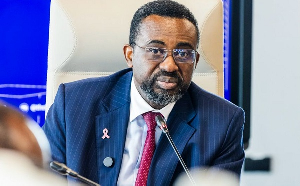
 Dr Johnson Pandit Asiama is the Governor of the Bank of Ghana
The Governor of the Bank of Ghana, Dr Johnson Pandit Asiama, has said inflation has declined sharply to 4.6% in July 2026, reflecting renewed progress towards economic stability.
He attributed the decline to a combination of disciplined monetary policy, fiscal consolidation and structural reforms under Ghana’s International Monetary Fund (IMF)-supported programme.
Dr Asiama noted that headline inflation had risen above 54% at the height of the country’s recent economic difficulties.
Speaking at the launch of the Ghana Investment Promotion Authority (GIPA) 2025 Annual Investment Report on Friday, August 21, 2026, he said the local currency had also recorded a significant recovery against major international currencies, while external reserves had strengthened and economic activity had gained momentum across sectors.
He further said growth had become increasingly broad-based, supported by improvements in the services and agriculture sectors, alongside a gradual recovery in industry.
“These developments have contributed to creating a more stable and predictable environment for businesses and investors,” he said.
Dr Asiama said he was encouraged by the findings of the GIPA 2025 Annual Investment Report, describing them as a reflection of renewed investor confidence in Ghana’s economic prospects.
“This is a strong indication that investors continue to see the opportunities that exist within our economy. Equally important is the quality and nature of these investments,” he stated.
He said existing investors were not only maintaining their presence in Ghana but were also expanding their operations and reinvesting in the economy.
“We are also witnessing increasing interest in sectors such as manufacturing, agribusiness, logistics, and technology-enabled services,” he said.
Dr Asiama said the trend was consistent with Ghana’s broader economic ambition of transitioning from an economy that primarily exports raw materials to one that creates greater value through industrialisation, innovation and competitiveness.
He also noted growing confidence among Ghanaian businesses.
“The participation of locally owned enterprises, including the registration of 71 wholly Ghanaian-owned projects valued at nearly US$686 million, demonstrates that domestic investors continue to believe in Ghana’s long-term potential,” he said.
Despite the improvement in key macroeconomic indicators, Dr Asiama disclosed that Ghana’s gross international reserves had declined by about US$1.2 billion due to pressures arising from tensions in the Middle East.
He said the development underscored the vulnerability of Ghana’s external position to global shocks, even as the economy continued to make progress on the domestic front.
ANAS/MA
Ghana's recovery due to superior economic management - Ato Forson

Copyright © 1994 - 2026 GhanaWeb. All rights reserved.










