



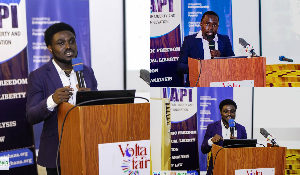
 The call was made at the maiden Inheritance Clinic and Dialogue held in Ho in the Volta Region
The Institute for Liberty and Policy Innovation (ILAPI) has called for urgent reforms to Ghana’s inheritance system to make it easier and faster for families to access funds and assets left behind by deceased relatives, as about GH¢500 million remains in dormant accounts.
The institute said bureaucratic procedures, high costs and complex verification requirements at banks, insurance companies and pension institutions were locking beneficiaries out of their rightful inheritance and pushing vulnerable families into what it described as “inheritance poverty”.
The call was made at the maiden Inheritance Clinic and Dialogue held in Ho in the Volta Region on September 10, 2026. The event was organised by ILAPI in partnership with the Centre for Legitimacy and Rule of Law (CLRL) and LoveAid Foundation.
The Chief Executive Officer of ILAPI, Peter Bismark Kwofie, said the institute’s research had revealed the scale of dormant funds in the country and the difficulties beneficiaries faced in accessing them.
He said 1,448,660 dormant accounts had been transferred to the custody of the Bank of Ghana between January 2021 and July 2024, while dormant funds accumulated between 2016 and 2024 amounted to about GH¢500 million.
Kwofie said the figures underscored the need for the state and financial institutions to establish a more effective system to enable legitimate beneficiaries to identify and access funds belonging to deceased relatives without being subjected to unnecessary administrative hurdles.
ILAPI Researcher, Stephen Dansu, said the institute’s research showed that beneficiaries often had to deal with several institutions and satisfy multiple documentary requirements before they could access funds belonging to deceased relatives.
He said beneficiaries were sometimes required to travel from one institution to another to obtain documents and complete verification processes, imposing considerable financial costs on families already dealing with bereavement.
Such expenses, he said, could leave families worse off, particularly where the amount eventually recovered from a deceased relative’s account was less than the money spent on transportation and other costs associated with accessing the funds.
Dansu said 51.30 per cent of participants in the research reported that it took more than a year to complete the process of accessing funds belonging to deceased relatives.
He added that beneficiaries could be required to deal with as many as 14 institutions, describing the situation as a major administrative burden that needed to be addressed.
He said the consequences were particularly severe when the deceased was the main breadwinner of a family, noting that the research indicated that the death of one breadwinner could push about six people into poverty.
Dansu therefore described the inability of families to access inherited funds promptly as a dimension of systemic poverty and called for reforms to prevent bereaved families from falling deeper into financial hardship.
Kwofie called on the Bank of Ghana, National Insurance Commission (NIC), National Pensions Regulatory Authority (NPRA) and Parliament to dismantle complex administrative barriers and introduce a streamlined, faster and more compassionate verification process.
He also rejected proposals for the state to use dormant funds to finance national development, arguing that the funds remained private property and that inactivity did not mean the owners had abandoned them.
As part of its proposed reforms, ILAPI called for the passage of a single Next of Kin and Beneficiary Access Act to standardise procedures for accessing bank accounts, pension benefits and insurance claims.
The institute also proposed a central digital claims portal linked to Ghana Card data to trace, verify and notify beneficiaries when accounts become dormant.
It further called on the Bank of Ghana to publish a public register and annual report on dormant funds to create awareness and enable families to identify assets that may belong to them.
Additionally, ILAPI proposed the establishment of an Independent Dormant Asset Trust to invest dormant and unclaimed funds, with returns used to support social interventions, innovation and social enterprises. It said the government could borrow from the proposed fund and repay it rather than taking ownership of the assets.
Dansu also disclosed that about nine out of every 10 Ghanaians do not have written wills, according to the institute’s research, a situation he said could further complicate succession and inheritance processes.
He encouraged Ghanaians to develop the habit of writing wills as part of their financial planning, stressing that having a will did not mean a person was preparing for death or that it would necessarily create conflict within the family.
The Executive Director of LoveAid Foundation, Princess Lovia Tetteh, said inheritance was particularly important in the Volta Region because disputes over property, spousal rights, child support and family welfare could have wider implications for family stability and gender relations.
She urged young people, professionals and families to think beyond wealth creation and consider how their assets would be protected and transferred to their loved ones.
She said the dialogue was important in extending conversations on inheritance beyond the Greater Accra and Ashanti regions and encouraging families to examine their wills, policies and arrangements for managing their wealth.
The organisers said the dialogue was aimed at bridging gaps between customary and statutory succession systems and promoting a fairer financial system in which bereaved families could access their legitimate inheritance without unnecessary financial and administrative hardship.

Copyright © 1994 - 2026 GhanaWeb. All rights reserved.










