



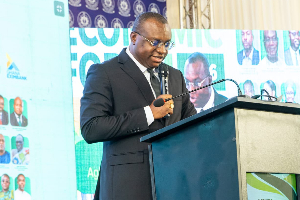
 Ernest Brogya Genfi, is the Presidential Adviser on National Resilience
The Presidency has pledged to work with the Volta Regional Minister and relevant government institutions to help clear avoidable bureaucratic and institutional bottlenecks that may delay credible investment projects emerging from the Volta Economic Forum.
The commitment was contained in an address delivered on behalf of the Chief of Staff, Julius Debrah, by Presidential Adviser on National Resilience and Emergency Preparedness, Ernest Brogya Genfi, at the 2026 Asohli Teza Edition of the Volta Economic Forum in Ho.
Held under the theme “From Opportunity Showcase to Investment Execution,” the forum brought together investors, business leaders, entrepreneurs, project promoters, traditional authorities and government institutions to explore investment opportunities in the region.
Brogya Genfi said the Office of the Chief of Staff was strategically positioned to facilitate coordination among ministries, departments and agencies where such collaboration was necessary to move viable projects from conception to implementation.
“The Chief of Staff sees every day how easily a sound project can slow down when institutions work in isolation. His role is to help the President translate policy into results by bringing ministries and agencies around the same table, tracking decisions and clearing avoidable obstacles,” he said.
He assured stakeholders that the Office of the President was prepared to support credible projects from the forum that required coordination at the national level.
“The Office of the President stands ready to work with the Regional Minister and the relevant institutions on credible projects from this Forum that require coordination at the centre,” Brogya Genfi said.
He, however, stressed that government support could only be effective when project promoters had undertaken the necessary preparatory work.
He said investors could not be expected to commit capital to broad concepts without the technical, commercial and financial information required to assess their viability.
“Investors cannot finance potential in the abstract. A serious proposal must answer basic questions: Is the land secure? Has the feasibility work been done? What approvals are required? Who will buy the product or service? How much capital is needed, and what return can the investor reasonably expect?” he said.
Brogya Genfi also challenged the organisers of the forum to develop a focused pipeline of investment-ready projects, rather than allowing discussions to end with expressions of interest.
He proposed that each project emerging from the forum should have an identified lead, clear financing requirements, a defined next decision and a timetable for follow-up.
A dedicated team, he added, should track commitments and regularly report on progress.
“When we meet again, our agenda should begin with an honest account of what moved, what stalled and what must be fixed,” he said.
The emphasis on project preparation and follow-through comes as the government advances the Volta Economic Corridor, which has been approved as a national project and designated Ghana’s first net-zero economic corridor.
The Volta River Authority, the 24-Hour Economy and Accelerated Export Development Secretariat and the Ghana Infrastructure Investment Fund began negotiations in August on a Master Concession Agreement intended to establish a commercial and legal framework for attracting long-term private investment into the corridor.
Brogya Genfi said the responsibility for converting the region’s economic potential into tangible development could not rest with the government alone.
He said the government must provide stable policies, enabling infrastructure and timely decisions, while financial institutions should develop financing instruments suited to sectors including agriculture, tourism, manufacturing and growing local enterprises.
Traditional authorities, he added, had an important role in facilitating land access, building community confidence and protecting investments over the long term.
The private sector, meanwhile, must bring capital, management expertise and market discipline to ensure that projects become sustainable businesses.
“When each party does its part, good projects have a genuine chance to succeed,” he said.
Brogya Genfi further stressed that investment in the Volta Region must ultimately translate into opportunities for people within local communities.
He said major investments should create opportunities for farmers, artisans, transport operators, suppliers and young professionals, while women-led businesses and young entrepreneurs should have fair access to procurement, training and finance.
“Development becomes real when families can trace it to a job, a reliable market or a stronger local business,” he said.
He cited farmers in South Tongu who need dependable buyers, young entrepreneurs in Ho seeking to expand their businesses and fishermen along the Volta Lake who require facilities such as cold storage as examples of the practical needs investment should address.
Brogya Genfi said these groups represented the people whose livelihoods should ultimately reflect the success of the investment initiatives being discussed.
He therefore urged stakeholders to focus on measurable outcomes and ensure that the Volta Economic Forum becomes a platform where promising ideas are converted into bankable projects, funded investments and jobs.
“The Volta Region has spent enough time being described as a place of promise. Let this Forum help turn that promise into progress people can see and livelihoods they can feel,” he said.

Copyright © 1994 - 2026 GhanaWeb. All rights reserved.










