



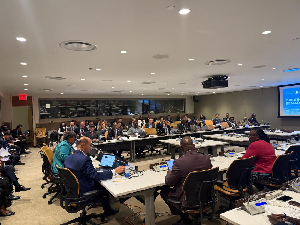
 Some of the stakeholders at the event
Ghana has called for the Climate Vulnerable Forum (CVF) to move decisively from designing new financial mechanisms to delivering projects that protect people’s lives.
Speaking at the Fourth CVF Leaders Meeting on behalf of President John Dramani Mahama, Minister of Climate Change and Sustainability Hon Issifu Seidu proposed that members extend Barbados’s presidency for another year so that two major initiatives can reach implementation. Many member states supported the proposal and unanimously adopted.
The meeting, held at UN Headquarters on the margins of UNGA 81, brought together leaders and ministers from climate-vulnerable countries under the theme “Development Reset and Cooperation.” Barbados Prime Minister Mia Amor Mottley chaired the gathering. Ghana spoke as a member of the CVF-V20 Troika, alongside Barbados and Bangladesh.
Two years after Ghana handed the presidency to Barbados, Minister Seidu said the Forum had made substantial progress under Prime Minister Mottley’s leadership.
The Vulnerability to Viability (V2V) Compact has moved from an idea for changing development finance to a framework for bringing more affordable, longer-term capital to vulnerable countries.
The proposed Lifeline Fund, he said, is now within reach of becoming operational.
“This is not incremental progress. It is the Development Reset we set out to achieve,” he told leaders.
Ghana’s request for continuity came with a practical reason. The V2V Compact’s White Paper was still due to be launched, and the Lifeline Fund still needed founding members.
Changing leadership at that stage, the Minister argued, could interrupt work at its most delicate point. CVF leaders subsequently endorsed an extension of Barbados’s presidency for a further year.
Minister Seidu also looked beyond that extension. He invited countries in Asia and the Pacific to signal interest in holding the next presidency, so that the eventual handover would be prepared and would preserve the Forum’s tradition of regional rotation.
Ghana welcomed former Costa Rican President Carlos Alvarado Quesada as the incoming second Secretary-General, expressing confidence that he could help turn the Compact and Fund into working instruments.
The wider Leaders Meeting set out the scale of the task. CVF members called for US$1.3 trillion annually in climate finance by 2035, including delivery of the developed-country-led US$300 billion annual goal.
They also pressed for faster clean energy investment, stronger climate science and early warnings, and a greater voice for climate-vulnerable nations in global decision-making.
For Ghana, the test is what these commitments produce. Minister Seidu said the country would continue advancing its Climate Prosperity Plan and stand ready to support the CVF-V20 Secretariat, which is headquartered in Accra, as it works with member states.
He offered leaders a direct measure of success: “The measure of this Reset will not be the declarations we adopt today, but the water systems, schools, and hospitals it finances across our membership.”
That message gave Ghana’s intervention its urgency. Climate-vulnerable countries have built a common voice and proposed new ways to finance resilience.
Their next task is to make those arrangements work at a scale communities can see and to ensure that climate cooperation reaches the people it was created to serve.

Copyright © 1994 - 2026 GhanaWeb. All rights reserved.










