



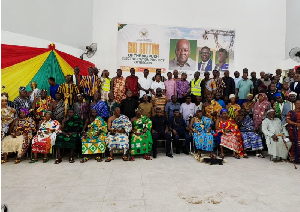
 Participants of the launch
The Ministry of Energy and Green Transition has launched the Turnkey Electrification Project under the Rural Electricity Acceleration and Urban Intensification Initiative (REIP) in the Oti Region, with 90 communities across all nine districts expected to benefit from the project.
The initiative seeks to extend electricity supply to communities currently without access to electricity while also improving and intensifying existing electricity networks to enhance reliability and support socio-economic development.
Speaking at the sensitisation and launch ceremony, the Engineer in charge of Power at the Ministry of Energy and Green Transition, Ing. Sulemana Abubakar, said the project formed part of the President's directive to ensure rural electrification across all 16 regions of the country.
He explained that the Ministry of Energy and Green Transition had been tasked with implementing the project with the support of the Electricity Company of Ghana (ECG) and the Northern Electricity Distribution Company (NEDCo).
According to him, Le-Grino had been selected to undertake the electrification works across all nine districts in the Oti Region, namely Guan, Buem, Akan, Biakoye, Nkwanta South, Nkwanta North, Krachi Twuburu, Krachi West and Krachi East.
In his opening remarks, the Oti Regional Minister, Hon. John Kwadwo Gyapong, said the project would contribute significantly to the development of the Region.
He described electricity as an “enabler for development and not an end”, noting that access to reliable electricity would create opportunities for citizens and strengthen socio-economic activities.
The Minister expressed appreciation to the Government for selecting 90 communities in the Oti Region to benefit from the Turnkey Electrification Project.
He noted that Oti, as the youngest region in Ghana, had a strategic location and significant potential to contribute to the country's economic growth.
Hon. Gyapong stressed the importance of electricity to schools, health facilities and businesses, saying improved electricity access would help create an environment in which citizens could thrive and promote stability and socio-economic development.
He therefore called on communities and traditional authorities to support the implementation and protection of the project, stressing that the sustainability of electricity infrastructure required collective responsibility.
He assured the stakeholders that the Regional Coordinating Council was ready to work with all relevant institutions to ensure the successful implementation of the project.
Launching the project, the Deputy Minister of Energy and Green Transition and Member of Parliament for Gomoa West Constituency, Hon. Richard Gyan-Mensah, explained that the Rural Electrification and Urban Intensification components of the initiative were designed to address two different but complementary needs.
He said the urban component would focus on intensifying and improving existing electricity networks, while the rural component would extend electricity supply to communities that currently do not have access.
He disclosed that the Ministry's strategy was to focus on all 16 regions over the next four years, with Volta, Oti, Savannah and the North East regions among those receiving attention this year.
Hon. Gyan-Mensah further announced that the Government had released 2,000 distribution transformers for installation by ECG and NEDCo to help improve electricity supply stability.
For communities that are located far from the existing distribution network, he said the Government was considering the deployment of mini-grid systems as an alternative means of providing electricity.
He also mentioned plans to improve community and highway lighting through solar technology, noting that about 23,000 solar streetlights were being provided across the country for community streetlighting.
He explained that under the arrangement, the Metropolitan, Municipal and District Assemblies would contribute part of the installation cost, while the Ministry would finance the remainder.
Addressing concerns about electricity supply and voltage stability in the Oti Region, Hon. Gyan-Mensah said Government was also working on the Eastern Corridor road and infrastructure connectivity that would support the broader development of the electricity network.
He mentioned ongoing plans involving connectivity from Ho to Asiekpe, Kadjebi to Ho, Adobire to Salaga, and Tamale to Salaga, to be undertaken in phases.
He said the interventions would contribute to improved electricity supply, voltages, and sustainable economic development within the beneficiary areas.
The Deputy Minister called on the Assemblies and traditional authorities to help protect electricity infrastructure and discourage illegal connections.
He further appealed to the Assemblies and Traditional authorities to assist in protecting the right-of-way required for the successful execution of the projects.
He emphasised that while the Government was committed to ensuring that every community had access to electricity, consumers also had a responsibility to pay their electricity bills, observe electrical safety precautions and conserve energy.
The Overlord of Chonke, Nana Bondja Kwame II, in his welcome address, expressed appreciation to the Government for the electrification intervention.
He appealed to the Deputy Minister and the Ministry of Energy and Green Transition to ensure that electricity supply in the Oti Region remained stable and reliable to sustain the development expected from the project.
The ceremony was attended by traditional leaders from all nine districts of the Oti Region, the Volta Regional General Manager, Ms Christina Jatoe-Kaleo, the Dambai District Manager, Madam Irene Mary Odame, among others.
The launch marks another significant step towards expanding electricity access in the Oti Region and creating the infrastructure needed to support economic activity, education, healthcare and improved livelihoods in beneficiary communities

Copyright © 1994 - 2026 GhanaWeb. All rights reserved.










