



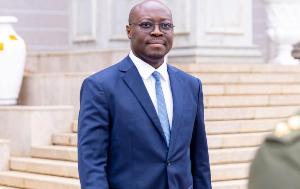
 Dr Cassiel Ato Forson is the Minister of Finance
S&P Global has maintained Ghana’s sovereign credit ratings at ‘B-/B’ for both long-and short-term foreign and local currency obligations, with the outlook remaining stable.
The ratings agency has also retained its ‘B-’ assessment on Ghana’s transfer and convertibility position.
According to S&P Global, the stable outlook is supported by expectations of continued improvement in Ghana’s balance of payments, further growth in foreign exchange reserves and progress in public financial management reforms.
The agency, however, identified several factors that could undermine the country’s credit position. These include Ghana’s high debt-servicing burden, contingent liabilities linked to state-owned enterprises (SOEs) and the Bank of Ghana, possible setbacks in implementing economic reforms, and the country’s increasing dependence on developments in the gold, cocoa and oil markets.
Factors that could lead to a downgrade
S&P Global said Ghana could face a ratings downgrade within the next 12 to 18 months if the government’s ability to refinance maturing obligations weakens.
Such pressure could emerge if fiscal deficits widen because of budget implementation challenges, or if the financial positions of the Bank of Ghana and state-owned entities, including the Ghana Gold Board (GoldBod), deteriorate.
A substantial increase in public debt or debt-servicing costs beyond current projections could also put pressure on the sovereign rating.
Government beats GH¢2.75 billion T-bill target despite falling rates
The agency further warned that weaker export volumes or an unfavourable shift in Ghana’s terms of trade could raise the country’s external financing requirements and increase its external debt, creating additional downgrade risks.
S&P Global said a prolonged deadlock in Ghana’s debt restructuring could also result in a downgrade, although this is not currently included in its baseline expectations.
Such a scenario could arise if creditors fail to reach agreement over the comparability-of-treatment principle or the terms of Ghana’s restructuring arrangements under the G20 Common Framework.
What could trigger an upgrade?
Ghana could receive a ratings upgrade if the government is able to sustain low fiscal deficits and bring down public debt and debt-servicing costs over the next 12 to 18 months.
S&P Global said stronger fiscal performance would improve the country’s ability to access external financing.
Further gains in Ghana’s external position would also be necessary, particularly through continued accumulation of foreign exchange reserves.
Gold sector boosts reserves but creates fiscal pressure
S&P Global said Ghana’s external position has continued to strengthen, with the expansion of gold exports playing an important role in improving macroeconomic stability.
The agency noted that the government is close to completing its broad debt restructuring programme, while higher gold exports in recent years have contributed significantly to the improvement in the country’s external accounts.
However, it cautioned that some of these gains are being offset by the fiscal burden associated with policies designed to build foreign exchange reserves rapidly.
S&P Global said Ghana’s ability to manage the fiscal costs and contingent liabilities linked to the rapid expansion of the gold sector will increasingly influence its capacity to service public debt.
The agency pointed to the strong performance of gold prices as another factor supporting Ghana’s external position. Gold now accounts for more than half of the country’s export receipts and nearly 10% of GDP.
Ghana recorded a current account surplus equivalent to 7.8% of GDP, or about $9 billion, in 2025.
The country’s gross international reserves also climbed sharply, reaching $12.9 billion as of June 30, 2026, compared with $4 billion in 2023.
S&P Global noted that Ghana is now the world’s sixth-largest gold producer and said the increase in external reserves gives the country greater protection against external economic shocks.
The agency added that the growing gold industry is strengthening Ghana’s external position, while the economy has shown relative resilience despite the economic impact of the conflict in the Middle East.
IMF programme and continuing fiscal challenges
S&P Global expects Ghana’s reform programme to continue, with the process receiving support from the International Monetary Fund’s new 36-month Policy Coordination Instrument (PCI), which does not provide direct funding.
Despite this, the ratings agency raised concerns about the financial condition of the Bank of Ghana.
It said the central bank’s financial position has weakened as the government pursues the rapid accumulation of foreign exchange reserves through gold exports, creating the need for substantial recapitalisation.
S&P Global also expects the fiscal costs associated with the operations of the Ghana Gold Board to remain significant.
The agency’s assessment therefore points to an improving external position and stronger reserves, but also underscores the need for Ghana to contain fiscal pressures, manage contingent liabilities and sustain its economic reforms to preserve or improve its credit standing.
Foundries, Machines and Jet Engines: Ghana’s untapped engineering potential
AK/AM

Copyright © 1994 - 2026 GhanaWeb. All rights reserved.










