



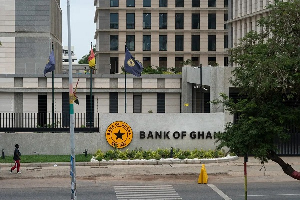
 Banks carried out 22.36 million credit enquiries in 2025
Ghana’s banks ran 97 per cent of their credit checks through a single credit bureau last year. The figure shows how lopsided competition is in a market the Bank of Ghana is about to reshape.
Banks carried out 22.36 million credit enquiries in 2025, according to the Bank of Ghana’s Credit Reporting Activity Annual Report 2025. Of these, 97 per cent were conducted on the database of XDS Data Ghana Limited and 3 per cent on that of Dun & Bradstreet Credit Bureau Limited. No bank searched the database of the third licensed bureau, MyCredit Score Limited.
The dominance matters because banks drive the market. They accounted for 86.28 per cent of all 25.92 million credit enquiries in the country last year.
XDS also led among other lenders. It handled 88.7 per cent of enquiries by non-bank financial institutions and 57 per cent of those by rural and community banks. Dun & Bradstreet took the remaining 11.3 per cent and 43 per cent respectively.
The one segment where XDS trails is microfinance. About 80 per cent of enquiries by microfinance institutions went to Dun & Bradstreet, against 18 per cent for XDS and 2 per cent for MyCredit Score.
Taken together, the figures suggest XDS handled about 89 per cent of all credit enquiries in the country in 2025, by this newspaper’s calculation, with Dun & Bradstreet at about 11 per cent and MyCredit Score well under 1 per cent.
The concentration is not about who holds the data. Under the rules, lenders must submit the same information to every licensed bureau. The report confirms the bureaus “receive the same number and type of data” from financial institutions. A Bank of Ghana notice issued in February 2026 reminded lenders that they must provide credit information on customers to all licensed bureaus within 72 hours of granting credit.
Instead, the bureaus compete on what they do with that data. The report says the difference between them “relates to their ability to provide credit reports that meet the needs of lenders.”
XDS has had a long head start. It was incorporated in 2003 and became the first credit bureau licensed by the Bank of Ghana under the Credit Reporting Act, in December 2008, beginning operations in 2010. It has been jointly owned by XDS South Africa, Databank Financial Services and Debenture Trust.
Dun & Bradstreet, linked to the US firm of the same name, was licensed and began operations in March 2012.
Competition has been fragile. A third bureau, Hudson Price Data Solutions, which began operating in 2011, had its license withdrawn by the Bank of Ghana in November 2022, leaving only two operators. MyCredit Score received a provisional license in 2024 and became the third bureau. The Bank of Ghana attributed its low number of enquiries in 2025 largely to “its recent entry” into the market.
The bureaus have been under pressure to raise their game. During 2025, the Bank of Ghana partnered with the International Finance Corporation (IFC) on a comprehensive assessment of the bureaus against the World Bank’s General Principles for Credit Reporting. It examined their technological readiness for services such as credit scoring and data analytics. The central bank said the key structural issues identified had been resolved by the bureaus.
The market the bureaus serve has grown rapidly. Total credit enquiries rose from 6.08 million in 2021 to 29.5 million in 2024, before easing 12.12 per cent to 25.92 million in 2025. Digital loans, driven largely by mobile money and payroll lending, now account for 76.94 per cent of all enquiries.
A big change is coming in 2026. The Bank of Ghana plans to develop a Data Hub for credit reporting, through which banks, lenders and utility companies would submit standardized data to the bureaus through the central bank, rather than sending it to each bureau separately.
The central bank says the current requirement to submit data to all bureaus at the same time has led to “late or non-submission to some bureaus and ultimately resulting in poor quality data.” The hub is meant to solve that.
The hub could alter the balance of competition. If every bureau receives complete, identical and timely data through the central bank, a newer bureau would no longer be disadvantaged by gaps in its records. Bureaus would then compete more directly on the quality of their reports, scoring and analytics.
The idea is not new. More than a decade ago, a former Governor of the Bank of Ghana, The late Kwesi Amissah-Arthur, suggested the central bank could participate in a central point that gathers data from banks and passes it on to bureaus, arguing that banks would trust the system more if the central bank was involved.
The stakes extend beyond the bureaus. Reliable credit information is central to the Bank of Ghana’s efforts to reduce bad loans. The central bank says the Data Hub is expected to improve data quality and support efforts to reduce non-performing loans in the banking industry.

Copyright © 1994 - 2026 GhanaWeb. All rights reserved.










