



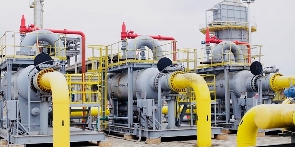
 The US$600 million project will increase gas export capacity from 210-220 million to 355 MMscf/d
Ghanaian consumers could benefit from greater stability in electricity tariffs as a US$600 million upgrade of the Sankofa offshore gas facility is expected to increase domestic gas supply and reduce reliance on expensive liquid fuels for power generation.
However, the extent of the benefit will depend on whether Ghana expands its gas processing infrastructure in time to handle the additional volumes and how the increased use of Sankofa gas affects the weighted average cost of gas (WACOG) used by the Public Utilities Regulatory Commission (PURC) in setting electricity tariffs.
Under a contract amendment signed on October 2, 2026, Yinson Production, operator of the Floating Production, Storage and Offloading (FPSO) vessel John Agyekum Kufuor, will install new gas compression and treatment modules at the Sankofa field, operated by Italian energy company Eni.
The US$600 million project will increase gas export capacity from the current 210–220 million standard cubic feet per day (MMscf/d) to 355 MMscf/d by the first quarter of 2028. The agreement also extends the vessel’s lease period by four years to 2036.
The additional supply could reduce the need for thermal power plants to switch to more expensive fuels such as light crude oil and distillate fuel oil during gas shortages, helping contain generation costs, foreign exchange expenditure and pressure on electricity tariffs.
Nevertheless, a significant reduction in consumer bills is not guaranteed. Sankofa produces non-associated gas, whose development and infrastructure costs differ from those of associated gas from fields such as Jubilee. Greater reliance on Sankofa could therefore influence the national WACOG and offset some of the savings from reduced liquid fuel use.
Processing capacity under pressure
Ghana’s existing Atuabo Gas Processing Plant, Train 1, has a peak capacity of 150 MMscf/d and typically operates at about 120 MMscf/d. already processing associated gas from the Jubilee and Tweneboa-Enyenra-Ntomme (TEN) fields, it has limited room to accommodate the additional Sankofa output.
To address the anticipated shortfall, the Ghana National Gas Company is developing a second processing facility, Train 2, at Atuabo. It will initially process 150 MMscf/d, with the capacity to scale up to 300 MMscf/d.
Together, the two plants would provide total processing capacity of 450 MMscf/d.
The project is estimated to cost between US$700 million and US$812 million, with financing structured through public-private partnerships, including support from the Africa Finance Corporation.
Train 2 will use turbo-expander technology to recover an estimated 80 percent of natural gas liquids, compared with 40–50 percent at Train 1. The improved recovery is expected to reduce LPG imports and save more than US$151 million annually in natural gas liquids losses.
Race to meet the 2028 deadline
Both projects are targeting completion ahead of the first quarter of 2028, making timely commissioning of Train 2 critical to processing the increased offshore gas supply.
Delays could create bottlenecks, potentially forcing Ghana to flare gas that cannot be processed and transported for domestic use.
If delivered on schedule, the combined investments could strengthen fuel security, reduce exposure to imported oil prices and improve the predictability of power generation costs. For consumers, the more immediate benefit may be protection against sharp tariff increases rather than a substantial reduction in electricity bills.

Copyright © 1994 - 2026 GhanaWeb. All rights reserved.










