



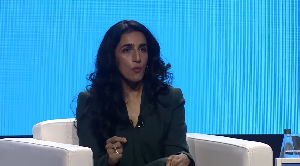
 Dr Ayesha Khanna is a technology expert
Artificial intelligence (AI) could undermine students’ critical-thinking skills if they rely on the technology to complete school assignments without developing their own understanding, technology expert Dr Ayesha Khanna has warned.
Speaking during an IMF Inspired session on unlocking human potential in the age of AI, on the sidelines of the 2026 IMF-World Bank Annual Meetings in Bangkok, Thailand, Dr Khanna expressed concern that students who use AI to complete homework may struggle to retain knowledge, formulate arguments and defend their ideas independently.
“I am concerned about this because it’s true,” she pointed out while adding that research had shown that students who used AI to complete homework performed worse in examinations.
According to Dr Khanna, excessive reliance on AI could leave students completing assignments without fully understanding the subjects they are studying.
“That means they are not retaining anything. That means they don’t know how to formulate arguments or defend their ideas,” she said.
She described the situation as a major challenge for young people, arguing that education systems must prepare students to work with AI without compromising their ability to think independently.
“This is very unfair on young people, that they are not given an education system that both simultaneously tells them how to work with AI, but also how to retain their ability to think for themselves,” she stated.
Dr Khanna, who works with businesses and governments on the practical application of AI, said schools and universities needed to rethink their teaching methods as the technology became increasingly important in the workplace.
She pointed to emerging educational approaches that teach students through real-world problems rather than focusing exclusively on individual subjects.
Dr Ayesha Khanna cited climate change and poverty as examples of issues around which learning could be organised, with AI serving as a tool to support students while they acquire the foundational knowledge needed to understand and solve problems.
This approach, she argued, would allow students to develop practical AI skills while maintaining their ability to reason, analyse information and form independent opinions.
The discussion also highlighted the challenge facing educational institutions in deciding when and how students should be introduced to AI.
While some schools and universities are restricting its use to ensure students first develop subject knowledge, Dr Khanna maintained that young people must also learn to use the technology because it is becoming part of the modern working environment.
“I think you have to give students AI skills. That is the new work environment,” she said.
However, Dr Ayesha Khanna stressed that the central issue was how to teach students to use AI effectively while preserving their capacity for independent thought.
Story by Mawuli Ahorlumegah, reporting from the 2026 IMF/World Bank Annual Meetings in Thailand, Bangkok

Copyright © 1994 - 2026 GhanaWeb. All rights reserved.










