



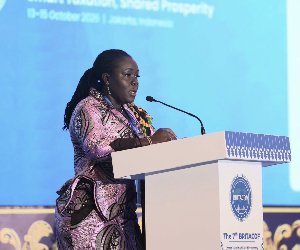
 Elsie Appau-Klu Esq is the Technical Adviser to the Commissioner-General of the GRA
The Ghana Revenue Authority (GRA) has showcased how artificial intelligence (AI) and digital tax systems are helping to improve revenue collection, citing GH¢1 billion in additional customs revenue generated in April 2026 through its Publican AI system.
The achievement featured prominently in Ghana’s contribution to the 7th Belt and Road Initiative Tax Administration Cooperation Forum (BRITACOF), held in Jakarta, Indonesia, from October 13 to 15, 2026, where tax administrators explored digital transformation, technology adoption and strategies for improving compliance across different economic environments.
Technical Adviser to the Commissioner-General of the GRA and head of the Ghanaian delegation, Elsie Appau-Klu Esq, delivered a keynote address during a digital transformation panel on the theme: “From Tax Informalization to Smart Taxation: The Ghanaian Experience and Shared Paths for Belt and Road Jurisdictions.”
Her presentation and contributions to the question-and-answer session highlighted Ghana’s efforts to combine advanced technology with accessible tax payment systems, particularly for businesses operating in the informal economy.
During discussions on how administrations at different stages of development could adapt digital reforms, Appau-Klu stressed that countries should not be expected to follow identical implementation paths.
She cited Ghana’s institutional evolution, noting that the country operated four separate revenue agencies in 2009 before making significant progress towards integration. The Ghana Card’s adoption as the Taxpayer Identification Number (TIN) in 2021 subsequently provided a foundation for broader digital reforms.
She explained that the GRA had adopted different approaches for different categories of taxpayers. While formal businesses use the Electronic Value Added Tax (E-VAT) system and application programming interfaces, informal operators can access the Modified Taxation Scheme through the *880# USSD platform and mobile money.
The scheme applies a flat three per cent tax, offering a simplified compliance channel for a sector she said accounts for approximately 70 per cent of Ghana’s economy.
Her central message was that tax administrations must adapt technology to taxpayers rather than force taxpayers to adapt to technology.
On the use of AI to improve revenue mobilisation, Mrs Appau-Klu cited Publican AI, deployed within the Integrated Customs Management System (ICUMS) in late 2025, as a practical example of measurable digital transformation.
The system analyses declared import values against international price databases, historical import records and electronic invoice data, while using taxpayer identification information to help identify anomalies before goods are released.
According to her, the system generated an additional GH¢1 billion in customs revenue in April 2026 alone, helping address undervaluation and revenue leakages.
She added that total GRA revenue increased from GH¢153 billion in 2024 to GH¢182 billion in 2025, with Customs identified as the biggest contributor to the increase. The authority is targeting GH¢310 billion in revenue by 2028.
Appau-Klu emphasised, however, that AI should support rather than replace human judgement. She said officers could review, accept or override system alerts, while taxpayers retained the right to appeal, helping strengthen transparency and trust.
She urged administrations beginning their digital transformation to establish a unified taxpayer identity and integrated data systems before investing heavily in AI.
The discussions also highlighted the importance of knowledge-sharing and capacity development. She proposed modular training programmes that would allow tax authorities to adopt solutions suited to their respective needs, while retraining tax officers to become data analysts rather than replacing them.
Reflecting on lessons from other jurisdictions, she identified Indonesia’s electronic VAT and stamp-duty systems as potential models for Ghana, particularly in embedding tax collection within digital transactions and mobile money payments.
She also cited China’s integrated Golden Tax System and business enterprise resource planning platforms as an example of “compliance by design”, where electronic invoices can become the basis of tax compliance rather than merely supporting subsequent tax returns.
Appau-Klu said Ghana would explore how these approaches could strengthen its E-VAT system and informal-sector taxation.
She invited participating administrations to Accra to learn from Ghana’s experience in taxing informal businesses through mobile money and USSD technology.
The Ghanaian delegation also included Moses Koloni Yidana, Head of the GRA’s Transfer Pricing Unit, and Abdul Rauf Nasiru, Head of the Telecommunications and Services, Large Taxpayer Office in the Audit Division.
Foundries, Machines and Jet Engines: Ghana’s untapped engineering potential

Copyright © 1994 - 2026 GhanaWeb. All rights reserved.










