


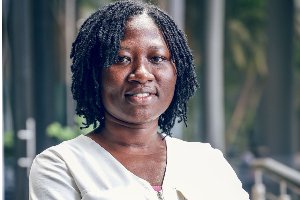
 Dr Mavis Owusuaa Osei, Lecturer, University of Ghana
Dr Mavis Owusuaa Osei-Wusu is among 47 women breeders chosen to lead more farmer-centred crop research.
A University of Ghana lecturer has been selected for a new fellowship that seeks to grow the number and influence of women in African plant breeding, a field in which women remain a small minority.
Dr Mavis Owusuaa Osei-Wusu is one of 47 women breeders from 14 African countries named today to the Gender Responsive Research for Optimized Women-led Breeding Systems (GROW) Fellowship. The cohort was unveiled in Nairobi at the launch of the Gender Responsive and Women-Led Research and Development Program by African Women in Agricultural Research and Development (AWARD).
For Dr Osei-Wusu, the fellowship is as much about the students she teaches as her own research.
"I expect the Fellowship to help me become a more confident and well-rounded leader, a stronger scientist and educator, and a more effective mentor to the students and early-career scientists who look to me for guidance," she said.
A gap in West Africa
Her selection comes against a stark backdrop. Women account for less than 15% of plant breeders in West and Central Africa.
Across the continent, women remain underrepresented in the senior research and management positions where research priorities are set and resources are allocated.
That gap matters for farmers, said Dr. Susan Kaaria, Director of AWARD. "Understanding what women and men farmers need is essential to developing agricultural innovations they can use," she said.
"However, gender responsive breeding does not only consider the representation, voice and agency of women farmers within crop improvement design, development and delivery, but should also consider who is conducting the crop breeding research."
The programme also responds to low uptake of breeding technologies among women smallholder farmers. When their priorities are missed in the design of new varieties, those varieties may not be adopted or sustained.
Training future scientists
Universities are central to the program's approach. In Ethiopia, Kenya and Nigeria, it will work with universities to review curricula and teaching so that future scientists are ready to apply gender-responsive breeding. Research institutes in those countries will assess gender gaps in their policies and practices.
As a lecturer, Dr Osei-Wusu is positioned to carry similar thinking into the classroom in Ghana. Mentoring is built into the fellowship: each fellow is paired with an experienced professional and later passes on what she has learned to an emerging leader.
Two years of support
Over the next two years, GROW Fellows will take part in face-to-face and virtual activities, including leadership and negotiation training, technical training on integrating gender into breeding research, structured mentoring, networking and peer learning.
"Through this Program, we are addressing a critical priority of supporting women breeders to lead research and working with institutions and universities to ensure that farmers' needs guide their research and the training of future scientists," Dr. Kaaria said.
Selection was competitive. "It was a very competitive process, so well done on being selected," Dr Kaaria told the fellows at the launch.
The programme is funded by the Gates Foundation and implemented by AWARD in partnership with Makerere University and Cornell University.
Since 2008, AWARD has graduated more than 1,200 fellows and worked in 26 African countries.
Inside Ghana’s Abandoned Engineering Powerhouse: What Went Wrong?

Copyright © 1994 - 2026 GhanaWeb. All rights reserved.










