


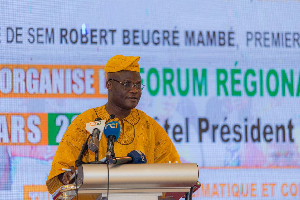
 Minister of Works and Housing, Ahmed Ibrahim,
Ghana must establish a national housing levy to secure sustainable funding for state-led residential projects and curb the nation’s 1.8 million housing deficit, Minister of Works and Housing, Ahmed Ibrahim, has proposed.
Speaking during a working visit to the State Housing Company, Ibrahim emphasised that a dedicated fund is vital to delivering affordable homes, particularly for young citizens struggling to secure decent accommodation.
Drawing comparisons with East Africa, the Minister highlighted Kenya’s model, where tax revenues are channelled directly into a dedicated housing fund to finance large-scale residential developments annually.
“Kenya, 200,000 is born out of the National Housing Levy by Kenya. It’s a tax. They put a tax, and they put those taxes in a fund which they use to build 200,000 housing units every year,” he noted. “So, if Ghana wants to build 200,000, 179,000 housing units every year, can’t we do the same thing?”
Addressing political apprehensions surrounding new tax measures, Ibrahim acknowledged that fear of public backlash often hinders decisive policy choices, yet insisted long-term interventions are essential.
“Every politician is always afraid. I want to bring a levy for housing, but I’m scared. Ghanaians will revolt,” he admitted.
The Minister urged political actors to treat shelter as a critical national imperative alongside water and employment rather than a partisan topic, noting that housing investments could simultaneously alleviate youth unemployment.
“Building or housing is something we must confront frontally, both political parties. We must come together,” he urged.
In a related development during his tour of sector agencies, Ibrahim disclosed ongoing engagements with the Ministry of Finance to establish a statutory fund for the Ghana Hydrological Authority (GHA).
Established under Act 1085 in 2022 to oversee hydrological services, coastal protection, and flood forecasting, the Authority faces severe operational constraints, currently operating with just 89 staff against an authorized strength of 230.
To address the 141-personnel deficit and halt brain drain caused by unapproved conditions of service, the Minister directed the GHA Chief Executive Officer to present a detailed report outlining operational bottlenecks, assuring that government will pursue financial clearance for recruitment and improved staff welfare.

Copyright © 1994 - 2026 GhanaWeb. All rights reserved.










