


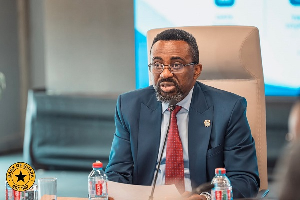
 Bank of Ghana Governor, Dr Johnson Pandit Asiama
Ghana’s economic managers have assured international investors and development partners that they will protect the country’s hard-won gains, using the just-ended IMF–World Bank Annual Meetings in Bangkok to set out commitments, from cutting bad loans in the banking sector to building reserves worth 15 months of imports, against which the recovery will now be judged.
Governor Dr Johnson Asiama and Finance Minister Dr Cassiel Ato Forson told investors and development partners that the discipline of the past two years would continue, even though the IMF’s bailout programme, and the financing that came with it, has ended.
The gains at stake are substantial. Inflation has fallen from 23.8 per cent at the end of 2024 to 5.2 per cent, public debt has dropped from 73.1 per cent of GDP before the domestic debt exchange to 45.9 per cent, and the central bank’s policy rate has been halved from 28 per cent to 14 per cent.
“Ghana has made substantial progress in restoring macroeconomic stability,” Dr Asiama told international investors at a Barclays roundtable on the sidelines of the meetings. “Our responsibility now is to make that progress durable by maintaining policy discipline,” he said, adding that the central bank would focus on rebuilding buffers.
The bad-loan deadline is the most immediate test. The Governor said regulated financial institutions had been directed to bring their non-performing loan ratios below 10 per cent by the end of December. The ratio has already fallen from 20.8 per cent to 15.7 per cent, but meeting the target would require a further cut of almost six percentage points over roughly the next ten weeks.
The central bank also wants the rebound in lending to reach the real economy. Private sector credit grew 36.4 per cent in the year to August, to GH¢124.2 billion, up from 13.3 per cent growth a year earlier, while average lending rates have fallen from 24.2 per cent to 15.9 per cent.
“Our priority is to ensure that this recovery in credit supports productive investment, business expansion and employment,” Dr Asiama said.
On reserves, the Governor reaffirmed the central bank’s commitment to the Ghana Accelerated National Reserve Accumulation Programme (GANRAP), the gold-backed plan launched in February, which targets import cover of 15 months by the end of 2028.
That remains a steep climb. Gross international reserves stood at about US$12 billion as of 22 September, equivalent to about 4.5 months of imports, according to the Bank of Ghana. Reaching the target in just over two years would require reserves to more than triple at today’s import levels.
Much depends on the Ghana Gold Board, which supplied US$1.17 billion to the central bank in September alone. But the Board has signaled that more of its dollars will go to commercial banks in October to support the cedi, highlighting the tension between steadying the currency today and building buffers for tomorrow.
Dr Asiama also listed longer-term institutional commitments, including a Fiscal Council to monitor public finances and the recapitalization of the Bank of Ghana along a legislated path by 2032, after the losses it absorbed during the debt crisis.
On the fiscal side, Dr Forson met IMF African Department Director Zeine Zeidane and said he had “reaffirmed our commitment to the fiscal credibility, discipline and bold reforms powering Ghana’s economic turnaround.”
The minister also set the bar above the IMF’s own upgraded forecast. “The IMF has upgraded Ghana’s 2026 growth forecast from 4.6% to 5.7%. We are confident we will exceed that projection,” he said.
The government’s recent record lends some weight to those words. The primary surplus reached 1.4 per cent of GDP between January and July, against a target of 0.2 per cent, while the overall deficit was 0.2 per cent of GDP, well inside a 1.9 per cent ceiling.
Keeping that discipline will be harder without the IMF’s money. Ghana’s US$3 billion Extended Credit Facility ended in May and has been replaced by a 36-month Policy Coordination Instrument, which provides IMF monitoring but no financing.
Dr Forson has framed the shift as a move from repair to growth. “Stabilization was never the destination. It was the price of entry,” he said ahead of the meetings. Details of the government’s New Economy programme are expected in the 2027 Budget in the first week of November.
The commitments were well received. Zeidane described Ghana’s IMF programme as “a great success,” although the Fund also urged central banks across Africa to remain “data dependent” as risks from energy prices and El Niño weather patterns build.
For investors, the promises now amount to a clear scorecard with which they can judge Ghana’s progress. By December, banks’ bad loans should be below 10 per cent. By the 2027 Budget, the New Economy programme should be on the table. By the end of 2028, reserves should cover 15 months of imports.
“That is how we will turn stabilization into lasting economic opportunity,” Dr Asiama said.

Copyright © 1994 - 2026 GhanaWeb. All rights reserved.










