


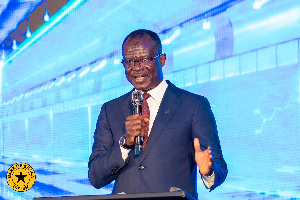
 Dr Zakari Mumuni is the First Deputy Governor of BoG
The Bank of Ghana has set out a four-point plan to unlock Asian investment in West Africa, including a mechanism to track progress against fixed deliverables and timelines, in a bid to turn investment forums into money on the ground.
First Deputy Governor Dr Zakari Mumuni presented the agenda in Bangkok last week Thursday at the High-Level West Africa–Asia Capital Dialogue, held on the sidelines of the IMF–World Bank Annual Meetings and convened by the ECOWAS Bank for Investment and Development (EBID). He spoke on behalf of Governor Dr Johnson Asiama.
“Success will be measured not by the number of discussions we hold, but by the investments made, the businesses expanded, and the partnerships sustained,” Dr Mumuni said.
The first step is to identify priority sectors and projects in West Africa that hold genuine commercial interest for Asian investors. For Ghana, he named agro-processing, manufacturing, energy, transport and logistics, digital services and financial technology, with the African Continental Free Trade Area opening access to a far larger regional market. Realizing that potential, he cautioned, will require improvements in trade facilitation, logistics, payment systems and dispute resolution.
The emphasis on commercial interest reflects a frank admission at the heart of his address. “Development needs do not automatically become investable opportunities,” he said, stressing that projects must be commercially viable, properly structured, backed by credible feasibility studies and supported by transparent risk allocation.
The second step is to establish structured engagement channels between African project sponsors and Asian investors, so that discussions move from general goodwill to specific deals.
Asian capital is already present in Ghana, but the flow of new money is thin. China led foreign direct investment by number of projects in 2025, with 70 of the 254 registered with the Ghana Investment Promotion Centre, and ranked second by value at US$486 million. Total FDI rose to about US$2.62 billion, roughly four times the 2024 level. Yet of the US$1.91 billion in net FDI captured in the balance of payments, 95.4 per cent came from earnings reinvested by companies already operating in the country, leaving first-time investors with a small share.
The third step is to expand collaboration on trade finance, payment connectivity and local-currency financing, the area where the central bank has the most direct stake.
“Long-term investments require long-term financing,” Dr Mumuni said. “Greater use of local-currency financing, where feasible, can help reduce currency mismatches and strengthen project viability.”
He said the Bank was open to innovations that improve cross-border payments and support trade and investment, provided they come with safeguards for resilience, integrity and regulatory compliance.
The fourth step is to create a mechanism for tracking progress against clear deliverables and timelines, with EBID and other regional development finance institutions playing a coordinating role. The proposal is aimed at a familiar weakness of such gatherings, where pledges are announced but rarely followed up.
Alongside the action plan, Dr Mumuni outlined four priorities he said would change the investment equation. These are better risk-sharing among development finance institutions, export credit agencies, governments and private investors, so that each risk falls on the party best able to manage it; stronger project preparation to build a pipeline of investment-ready projects; financing structures that match long-term projects with long-term funds; and lasting institutional partnerships that combine Asian capital and expertise with African market knowledge.
He listed the concerns investors raise most often as exchange-rate and financing risks, regulatory and policy uncertainty, difficulty enforcing contracts, infrastructure gaps, and problems exiting projects and managing risk. He urged Asian investors to assess opportunities on their individual merits rather than through broad regional perceptions, noting that conditions vary widely across West Africa.
“The challenge is not a lack of capital or investment opportunities, but confidence, risk perception, and effective investment structures,” he said.
The Deputy Governor presented Ghana’s recovery as evidence that credible policy can rebuild confidence. Inflation has eased to 5.2 per cent in September from above 23 per cent in late 2024, the country exited its US$3 billion IMF programme in May, and Moody’s last week raised Ghana’s sovereign rating to B3 from Caa1, its second upgrade in a year, following Fitch’s upgrade to B in May.
But he cautioned that stability alone would not attract investors. “Macroeconomic stability is necessary, but not sufficient,” he said. “Investors also require policy predictability, credible institutions, and well-prepared projects.”
He was equally clear about the limits of the central bank’s role. “Central banks cannot determine the commercial success of investment projects,” he said, describing the Bank’s job as maintaining price and financial stability, efficient payment systems and transparent foreign-exchange arrangements.
“Our responsibility in Africa is to make opportunities more investable,” he said. “Our partners’ responsibility is to assess those opportunities objectively and work with us to develop commercially viable solutions.”

Copyright © 1994 - 2026 GhanaWeb. All rights reserved.










