


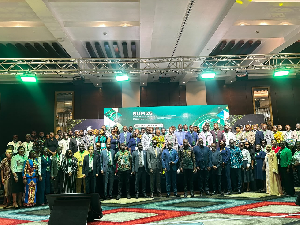
 Some of the stakeholders at the event
The Minister of State for Climate Change and Sustainability, Seidu Issifu, has called for stronger institutional coordination, increased private-sector investment and the effective implementation of climate policies to accelerate Ghana's transition towards a resilient, sustainable and competitive green economy.
He said Ghana must move beyond climate commitments and policy declarations to practical interventions that attract investment, create employment opportunities, protect livelihoods and strengthen the country's competitiveness in the evolving global economy.
Speaking at the Ghana National Climate and Environmental, Social and Governance (ESG) Policy Summit 2026, in Accra on October 27, 2026, Issifu stressed that climate action must become an integral part of national development planning, public investment and business operations.
The summit, organised by Intelligence Nature International under the auspices of the Office of the Minister of State for Climate Change and Sustainability, was held under the theme "Decoding Policy and Regulation for the Next Economy," with a focus on aligning the private sector with Ghana's green transition framework.
The event brought together government officials, policymakers, industry leaders, financial institutions, development partners, local government authorities and civil society organisations to discuss Ghana's climate policy environment and emerging international sustainability regulations.
Addressing participants, Issifu said Ghana's commitments under the Paris Agreement and its Nationally Determined Contributions (NDCs) provided an important foundation for climate action but required effective implementation to produce meaningful results.
"Commitments alone do not deliver transformation. Their value is determined by how effectively they are integrated into national development priorities, sector policies, public investment, local planning and private-sector decisions," he stated.
He explained that climate change affected virtually every sector of the economy, including agriculture, energy, transport, infrastructure, health, trade and finance, making coordinated national action essential.
Obuasi SHTS Abuse: Families of alleged victims consider relocating over stigma
According to him, the Office of the Minister of State for Climate Change and Sustainability would continue to promote policy coherence, strengthen collaboration among public institutions and support efforts to mobilise financing for climate-related programmes.
He called for the strengthening of Climate Change and Sustainability Units within public institutions, including Metropolitan, Municipal and District Assemblies (MMDAs), to improve climate-risk assessments, project development, stakeholder engagement and sustainability reporting.
"We must move from fragmented interventions to coordinated implementation; from isolated projects to programmes capable of delivering national impact; and from climate ambition to measurable results," he emphasised.
On climate financing, Issifu acknowledged that Ghana required substantial investments to develop climate-resilient infrastructure, modernise industries, expand clean energy and strengthen food systems.
He noted that public resources alone could not meet these financing requirements and urged greater participation from domestic financial institutions, international climate funds, development finance institutions and private investors.
The minister said attracting sustainable investment would require credible institutions, transparent financial management, sound governance and well-prepared projects capable of securing financing.
He encouraged financial institutions to incorporate climate-related risks into lending and investment decisions while supporting businesses seeking to adopt environmentally sustainable technologies.
"Climate finance is not merely an international development resource. It is an opportunity to finance innovation, improve productivity, manage risk and create new markets," he said.
He further urged businesses to integrate ESG principles into their corporate governance structures and long-term investment strategies rather than treating sustainability solely as a regulatory compliance requirement.
Issifu also drew attention to the implications of the European Union's Carbon Border Adjustment Mechanism (CBAM), which entered its definitive regime on January 1, 2026.
He explained that the mechanism introduced carbon-related obligations for selected imported products, including cement, iron and steel, aluminium, fertilisers, electricity and hydrogen.
The minister warned that Ghanaian manufacturers and exporters dealing in affected products needed to prepare for increasingly demanding emissions reporting and verification requirements.
He said the development had significant implications for industrial competitiveness, export markets, investment planning and Ghana's international trade relations.
Ghanaian businesses, he advised, must assess their production processes, energy sources and carbon footprints while investing in cleaner technologies and improved environmental performance.
"We should not view CBAM solely as a compliance challenge. It is also a signal of the direction in which international markets are moving," he stated.
He urged government agencies, industry associations, financial institutions and regulatory bodies to collaborate in building the technical capacity of affected businesses.
According to him, Ghana could turn emerging international climate regulations into opportunities for industrial modernisation, renewable energy investment, export diversification and job creation.
Touching on carbon markets, the minister stressed the need for transparency, accountability and credible emissions reporting as Ghana expands its participation in international carbon trading arrangements.
He said carbon markets offered opportunities to mobilise resources for forest conservation, sustainable agriculture, renewable energy and emissions-reduction initiatives.
However, he cautioned that such opportunities must be supported by reliable measurement, reporting and verification systems to prevent double counting and ensure genuine environmental benefits.
He also emphasised the importance of protecting local communities and ensuring that the benefits of climate-related investments were shared equitably.
Issifu said credible sustainability reporting would strengthen investor confidence and position Ghanaian businesses to compete more effectively in international markets.
In a separate keynote address, the Minister of Local Government, Chieftaincy and Religious Affairs, Mahama Ayariga, underscored the critical role of local authorities in translating national climate commitments into practical interventions.
The minister said the effects of climate change, including flooding, drought, pressure on water resources and threats to agricultural livelihoods, were most directly experienced at the community level.
Consequently, Metropolitan, Municipal and District Assemblies must be adequately equipped to implement climate adaptation and environmental sustainability programmes.
"It is also in our districts that national commitments must become practical results. Our Metropolitan, Municipal and District Assemblies are therefore at the frontline of Ghana's climate response and must be at the centre of our green transition," he said.
The minister called for climate and ESG considerations to be incorporated into the medium-term development plans and budgets of local assemblies.
This, the minister explained, would require stronger institutional capacity, improved access to financing and closer collaboration between central government institutions and local authorities.
Ayariga also stressed the importance of involving traditional authorities, women, young people and vulnerable communities in climate-related decision-making.
According to him, Ghana's green transition must be inclusive and equitable, ensuring that communities whose livelihoods depend on natural resources are not excluded from emerging economic opportunities.
Earlier, the Chief Executive Officer of Intelligence Nature International, Dr William K Bannerman, said Ghana's changing climate regulatory environment required greater collaboration among policymakers, financial institutions and businesses.
He explained that emerging regulations relating to carbon markets, sustainability disclosures, climate-risk management and international trade were creating new obligations for institutions and enterprises.
Dr Bannerman cautioned that uncertainty surrounding regulatory requirements could delay investments, increase compliance costs and place additional pressure on local assemblies already operating with limited resources.
"Uncertainty has a cost. When rules are unclear, investments wait, compliance becomes expensive," he observed.
He said providing clear regulatory guidance and ensuring consistent implementation would strengthen Ghana's ability to attract investment and maintain access to international markets.
"Clarity, on the other hand, is a competitive advantage," he added.
Dr Bannerman explained that the summit was designed to bring together institutions responsible for developing climate policies, financing the green transition and implementing sustainability measures.
He commended the government and participating institutions for supporting efforts to strengthen Ghana's climate governance and regulatory framework.
AM
Inside Ghana’s First 950,000-Barrel Sankofa Oil Shipment | Exclusive Tour
“We Can’t Adapt to This New Road Technology” | Ghanaians React to TRAFFITECH-GH

Copyright © 1994 - 2026 GhanaWeb. All rights reserved.










