


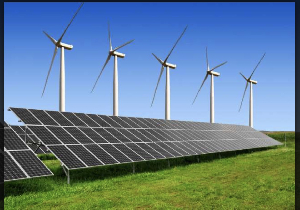
 A screenshot of wind turbines and solar pannels
The proposed Buipe Renewable Energy Project and expanding commercial solar developments are positioning renewable power as a potential source of competitively priced electricity for manufacturers, logistics operators and agro-industrial businesses.
Ghanaian manufacturers could significantly reduce their electricity costs under emerging renewable energy projects that promise to supply industrial users at prices substantially below prevailing grid tariffs.
The Buipe project, located in the Savannah Region, is designed to generate up to 1,500 megawatts of solar power supported by battery energy storage systems. Its stated objective is to reduce industrial electricity tariffs from approximately 18–23 US cents per kilowatt-hour to between 7 and 9 US cents.
The initiative is being pursued by the government through the 24-Hour Economy Secretariat, working with institutions including the Ghana Infrastructure Investment Fund, Ghana Investment Promotion Centre and Ghana Free Zones Authority.
A proposed commercial vehicle, 24H Parks Energy PLC, is expected to aggregate electricity demand from inland ports, logistics centres and agro-industrial parks to support the project’s commercial model.
A Joint Development Agreement was signed on April 10, 2026, with construction of the initial 100-megawatt phase scheduled to commence.
The project is intended to support the government’s 24-Hour Economy and Accelerated Export Development Programme by providing reliable electricity for businesses seeking to expand production and operate beyond conventional working hours.
Commercial solar investment is also gaining momentum. The International Finance Corporation and LMI Holdings have advanced financing for a 100 MW solar photovoltaic project at the Dawa Industrial Zone, following a US$39.5 million agreement signed in September 2026 under a broader US$100 million facility.
The project is expected to serve more than 100 industrial businesses across manufacturing, agro-processing, cement, steel, textiles and logistics, while reducing carbon dioxide emissions by an estimated 120,000 metric tonnes annually.
Indicative costs cited for captive industrial solar range from 90 to 140 pesewas per kilowatt-hour, compared with approximately 215 to 270 pesewas for grid electricity, depending on the consumer’s tariff classification.
Solar power purchase agreements can also offer greater price predictability through contractually agreed adjustments, reducing exposure to fluctuations in exchange rates and international fuel prices.
However, the anticipated savings depend on successful project delivery, adequate transmission infrastructure, reliable battery storage and bankable commercial agreements.
Mobilising domestic pension funds and equity investment could further support development, provided financing and payment risks are effectively managed.
If implemented successfully, these projects could strengthen industrial competitiveness, encourage local production and improve the economics of Ghana’s 24-Hour Economy ambitions.

Copyright © 1994 - 2026 GhanaWeb. All rights reserved.










